

Gold Star Pokémon Cards: How to Identify Them and What They Are Worth
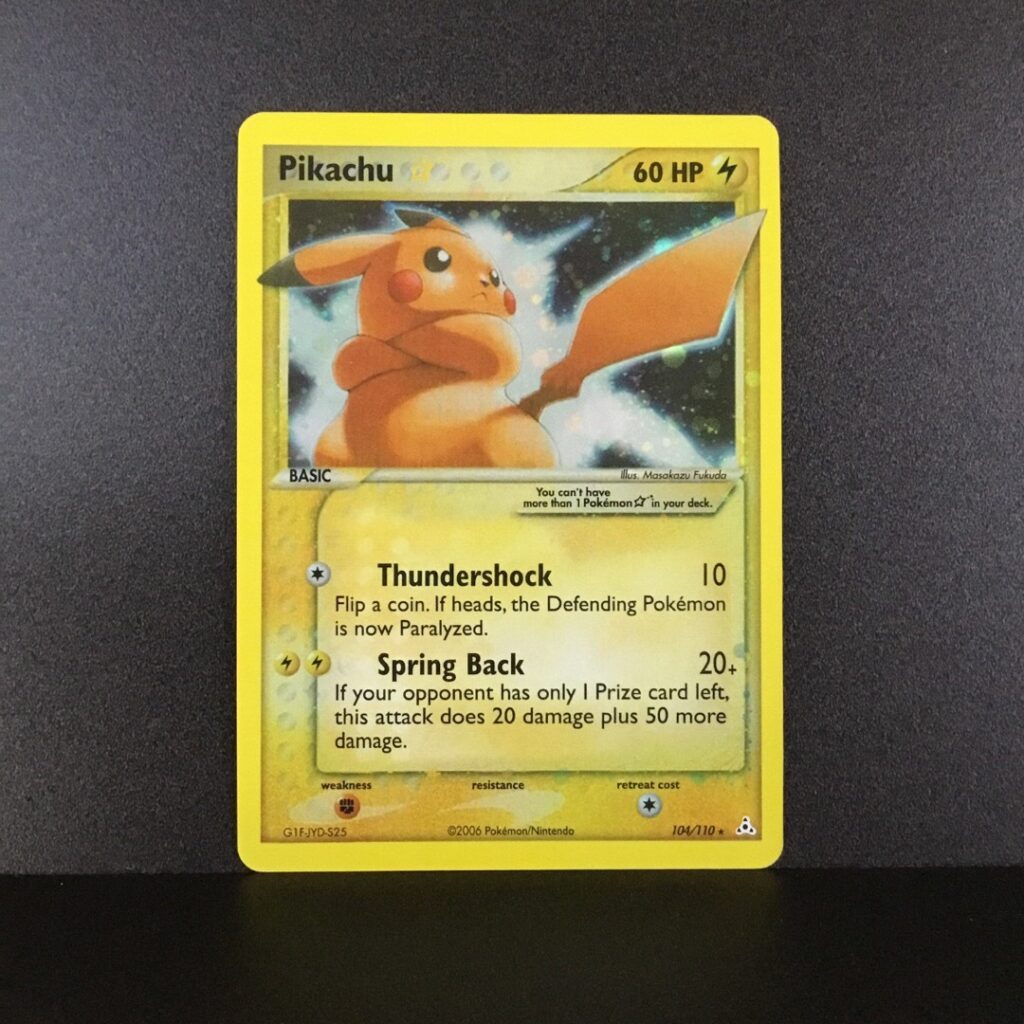
If you have spotted a small gold star printed next to a Pokémon’s name, you may be looking at one of the hardest-to-find rarity categories the Pokémon Trading Card Game has ever used. That star is the defining feature shared by every Gold Star card, and it sits next to the name rather than in the bottom corner where modern rarity symbols appear.
There are 27 Gold Star cards in English, and their price range is wider than that of almost any other vintage group. The least expensive ungraded card is worth roughly $703, while the most expensive PSA 10 is valued at about $375,000.
Every price in this guide was checked on August 27, 2026, so treat the figures as a snapshot and check a current pricing source before you buy. This guide walks through identification, the full 27-card list, current prices by grade, and how to buy Japanese Gold Star cards listed on marketplaces in Japan.
What Gold Star Pokémon Cards Are
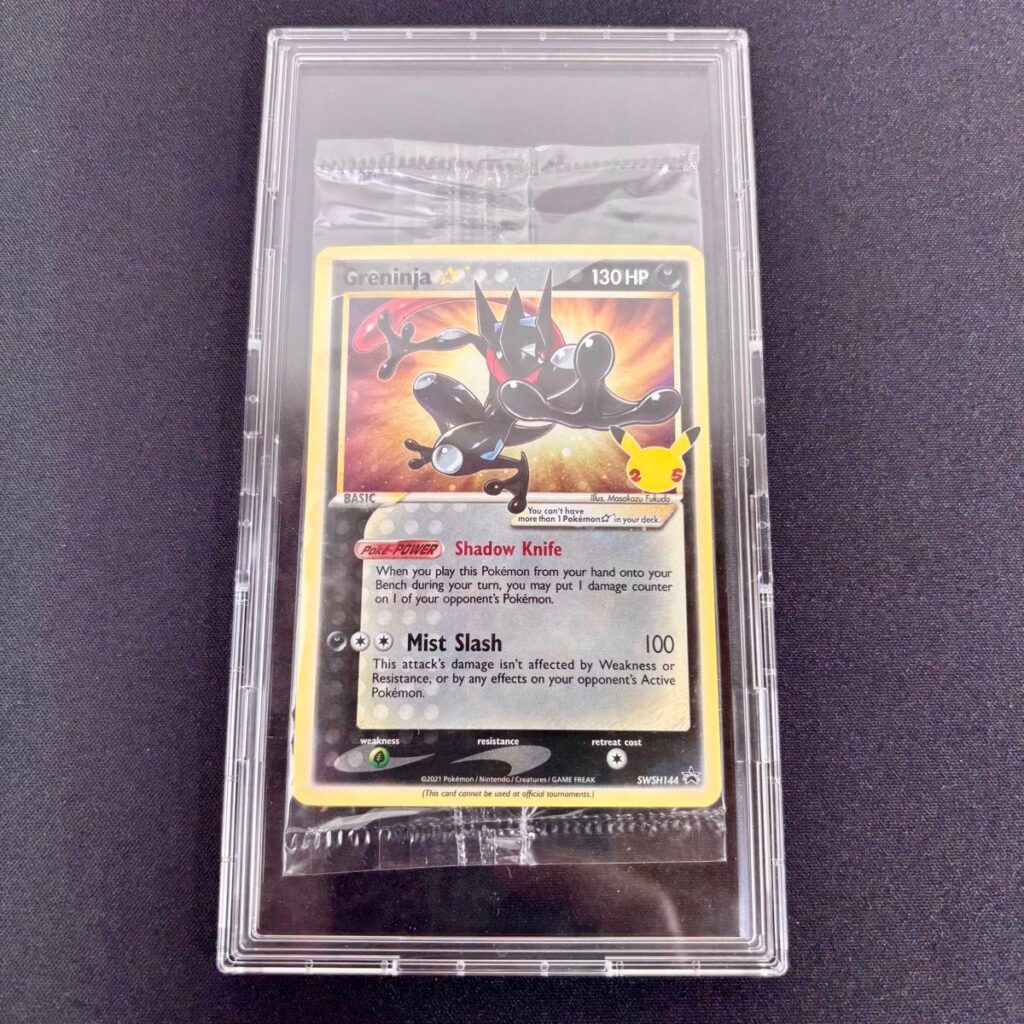
Gold Star is a rarity, not a card name. Three things define the group:
- The gold foil star next to the Pokémon name
- Shiny artwork that breaks out of the card frame
- An original release period that ended in 2007
The Gold Foil Star Next to the Pokémon Name
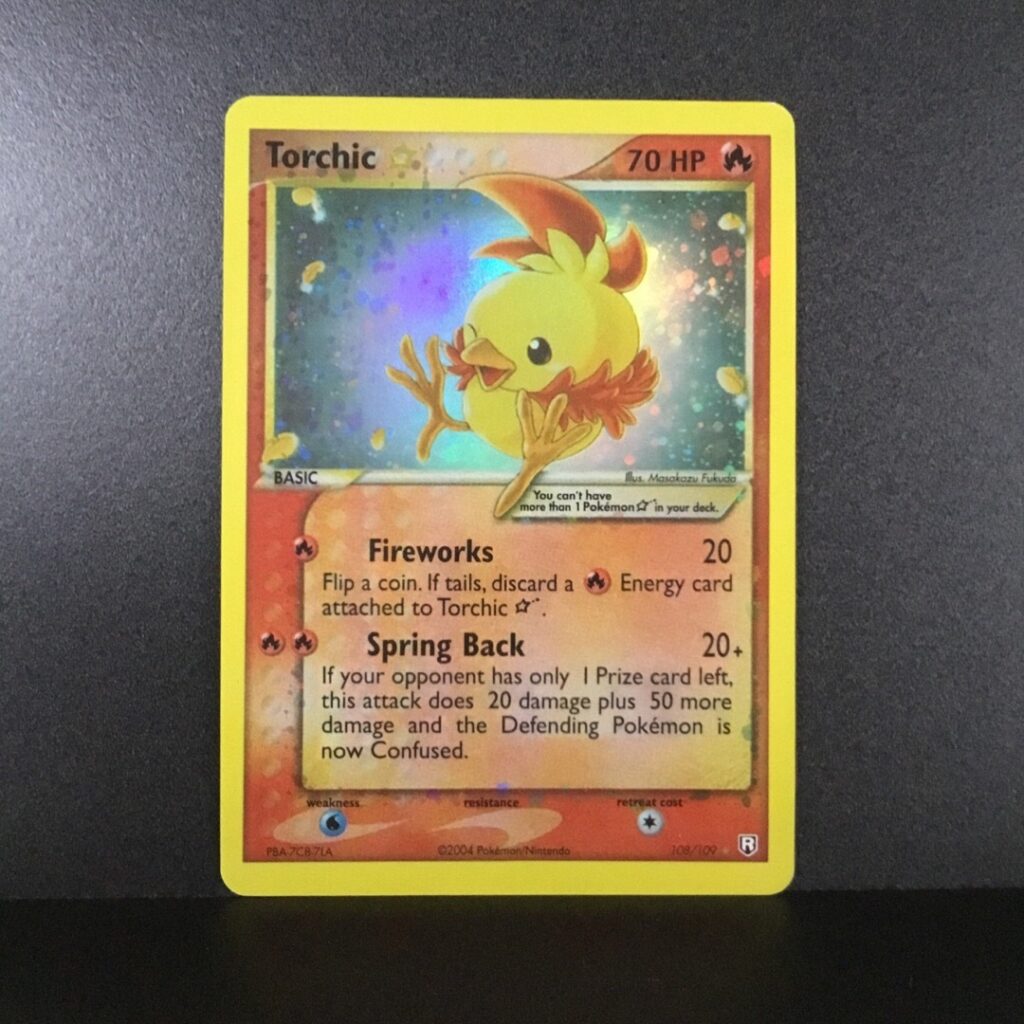
A Gold Star card is any card with a gold foil star printed directly after the Pokémon’s name. The official card database builds that star into the card name itself, as with Torchic ★ from EX Team Rocket Returns.
Pokémon ☆ is the official designation, while “Gold Star” is the nickname collectors adopted. Both refer to the same cards.
The star marks rarity and nothing else — not the Pokémon’s type, its evolution stage, or any gameplay mechanic. The Pokémon Company’s own card-set rarity guide lists it alongside common, uncommon, and rare.
Shiny Artwork That Breaks the Card Frame
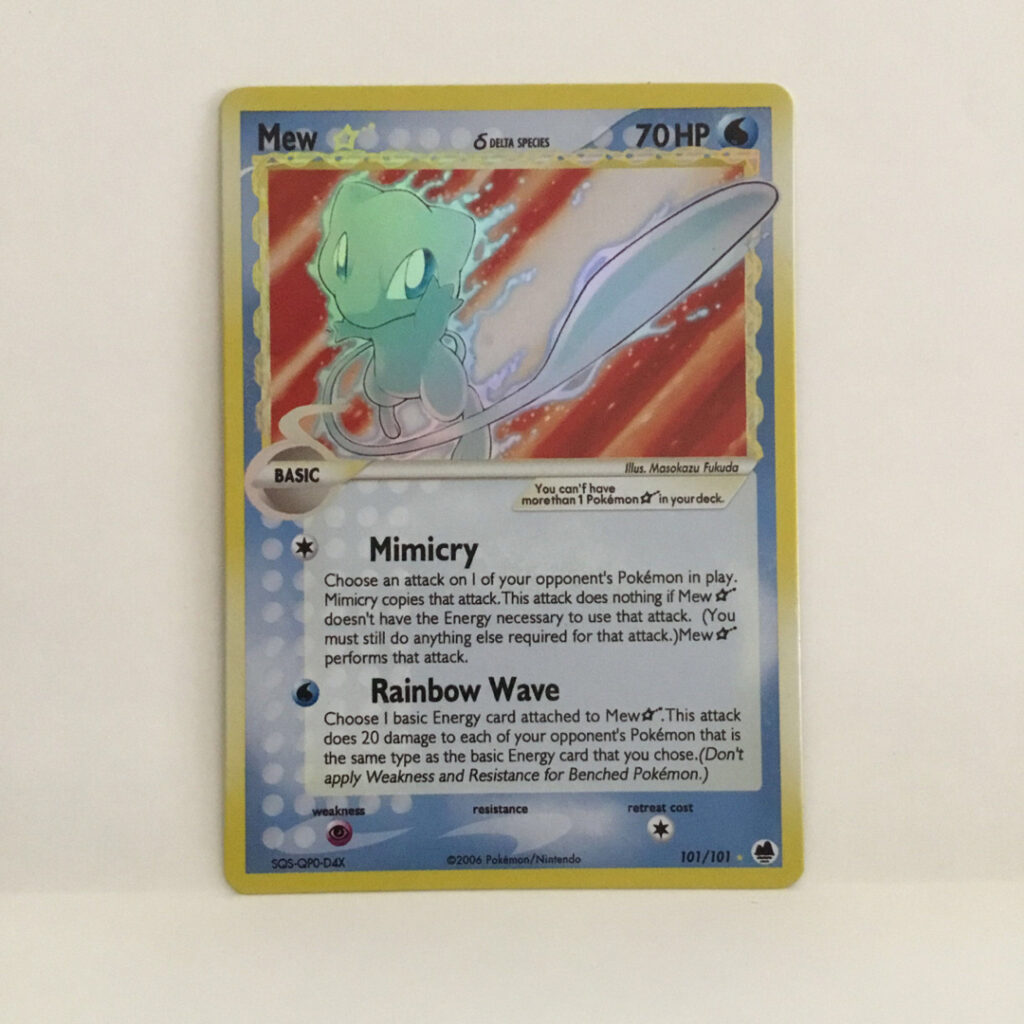
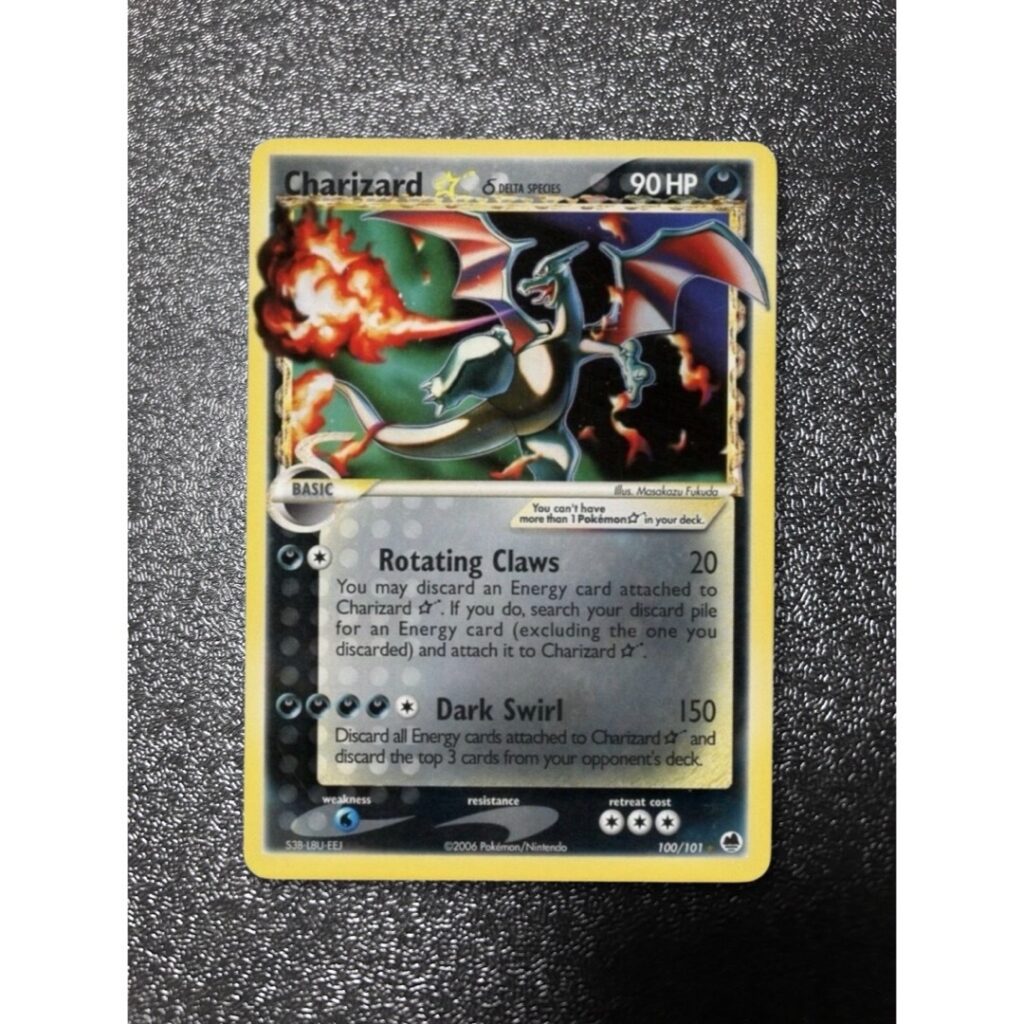
Every Gold Star card uses Shiny coloring instead of the Pokémon’s normal palette: a Gold Star Charizard is black, a Gold Star Umbreon blue-gray. The artwork typically extends past the illustration box and spills into the border, which gives these cards a more expansive visual feel than most cards from the same era. Once you have seen a few, that frame-breaking artwork becomes one of the fastest visual cues.
All 25 Gold Stars printed in the EX-era expansions share one illustrator credit: Masakazu Fukuda, listed in each set’s official card-set guide. That consistency gives you another quick reference point when a listing photo is hard to read.
Original Gold Star Cards Only Appeared Between 2004 and 2007
The original run started with EX Team Rocket Returns in 2004 and ended with POP Series 5 in March 2007.
Each card also carried a deck-building restriction printed on the card itself: you could only include one Pokémon ☆ in a deck. That rule appears in the official card text for every card in the group.
No current expansion uses the rarity. If you are searching for a modern set that contains Gold Stars, you will not find one, and the “Perfect Order” expansion that shows up in searches is a separate release with no connection to this rarity. Two cards released in 2021 revived the Gold Star design, and both are covered later in this guide.
How to Identify a Gold Star Pokémon Card and Spot a Fake
Evaluating a card involves two separate questions: whether it is a Gold Star at all, then whether it is genuine.
- Telling a Gold Star apart from a modern rarity symbol
- Reading the holo pattern
- Checking the print quality and the star itself
You can usually handle the first question visually. The second is harder: professional authentication provides the strongest confirmation, so treat the checks below as filters rather than proof.
The Star Sits Next to the Name, Not in the Corner
Modern Pokémon cards carry their rarity symbol somewhere else entirely. According to CGC, every Pokémon card is marked with a small symbol in the bottom right or bottom left corner, next to the set number. Those corner symbols are printed in plain black: a circle means common, a diamond means uncommon, and a black star means rare — not Gold Star.
A Gold Star card puts its star in gold foil immediately after the Pokémon’s name. The star’s location and color make the distinction easy to spot. The set symbol and card number beside the corner marking then tell you which expansion the card came from, which is what you check against the list below.
| What you see | Where it is | What it means |
| Gold foil star | Next to the Pokémon name | Gold Star (Pokémon ☆) |
| Black star | Bottom corner | Rare |
| Black diamond | Bottom corner | Uncommon |
| Black circle | Bottom corner | Common |
Real Holo Flakes Are Round, Not Polygonal
The holo layer is the detail counterfeits struggle with most. Collectors commonly look for round, evenly distributed holo flakes on genuine cards, whereas counterfeits may show more angular or coarse patterns.
Collectors also compare how the background reacts to light. Genuine cards tend to produce a smooth sweep of shine when tilted, while fakes often break into patches.
Neither check is conclusive on its own. For cards worth four figures or more, send the card to a grading company such as PSA or CGC, or buy a copy that has already been slabbed.
Further reading: How to Grade Pokémon Cards
Sharp Print and a Gold-Toned Star
Print quality is the second filter. Genuine cards tend to show crisp lettering and clean outlines, without the bleeding or visible dot pattern common on reproductions.
The star itself rewards a close look. Collectors describe a genuine star as showing a metallic gold sheen that shifts as you tilt the card, while a flat, matte yellow points to a reprint or a fake. Other details collectors check include color saturation, card thickness, the color of the card back, and how much light passes through the card.
Passing every check below still does not prove that a card is genuine, so consider a graded copy for higher-value cards, or send your own card in for grading before relying on a high-end valuation.
☐ Is the star printed next to the Pokémon name, not in the bottom corner?
☐ Does the star shift like metallic gold rather than sitting flat?
☐ Is the Pokémon in its Shiny coloring?
☐ Are the holo flakes rounded rather than angular?
☐ Is the text sharp, with no bleeding or visible dots?
☐ Do the card number and set symbol match a card on the list below?
Full Gold Star Pokémon Cards List: All 27 English Cards by Set
This list covers the 27 English Gold Star cards from the EX era, and nothing else. Japanese promos, the 2021 Greninja, and the Umbreon reprint use the design but sit outside the group, so they are covered in the next section.
- The 27 cards, set by set
- The two cards that never came from booster packs
The 27 English Gold Star Cards from the EX Era
The English run totals 27 cards. Twenty-five came from nine EX-era expansions, and the remaining two came from POP Series 5.
Every one of them appears near the end of its set’s numbering, which is why so many carry numbers like 100/101 or 115/115. If you are checking a card number against this table, start near the end of the set checklist.
| Set | Year | Card | Number |
| EX Team Rocket Returns | 2004 | Mudkip ★ | 107/109 |
| EX Team Rocket Returns | 2004 | Torchic ★ | 108/109 |
| EX Team Rocket Returns | 2004 | Treecko ★ | 109/109 |
| EX Deoxys | 2005 | Latias ★ | 105/107 |
| EX Deoxys | 2005 | Latios ★ | 106/107 |
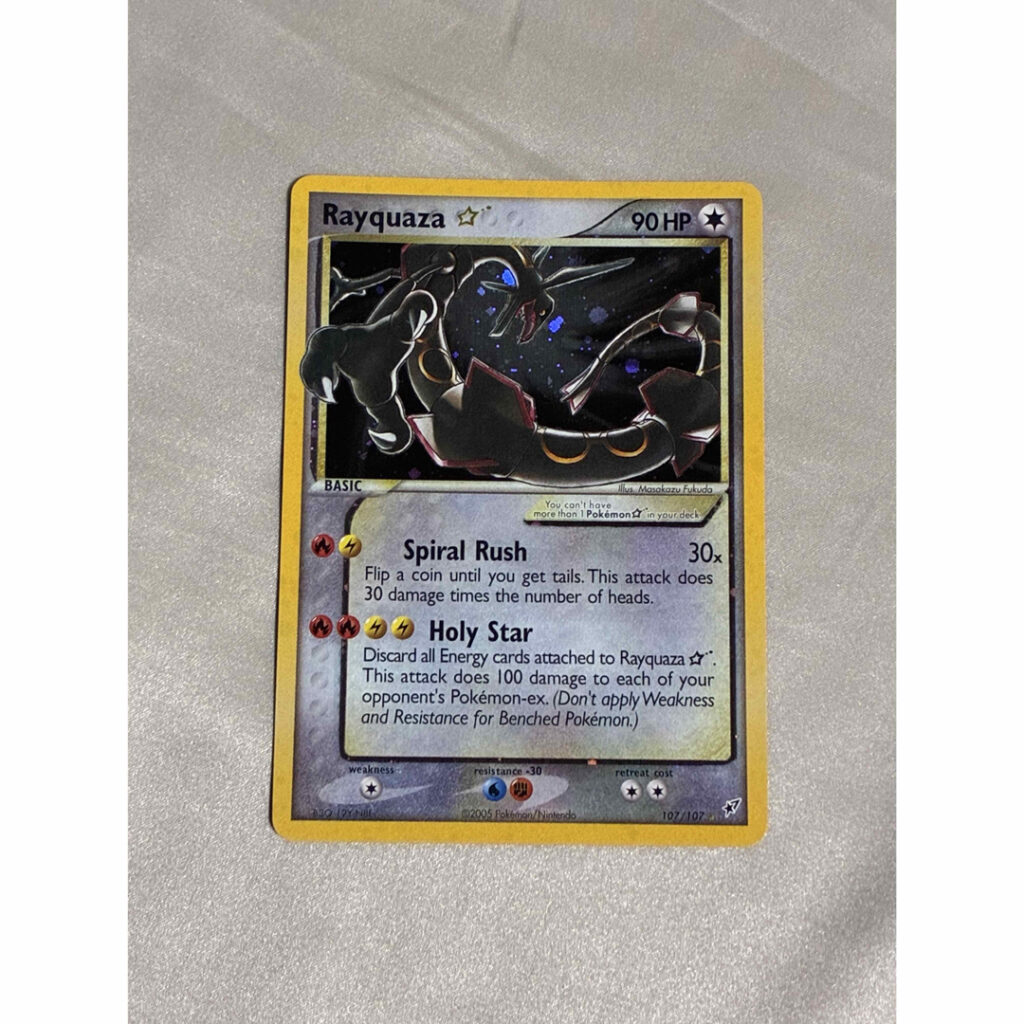
| EX Deoxys | 2005 | Rayquaza ★ | 107/107 |
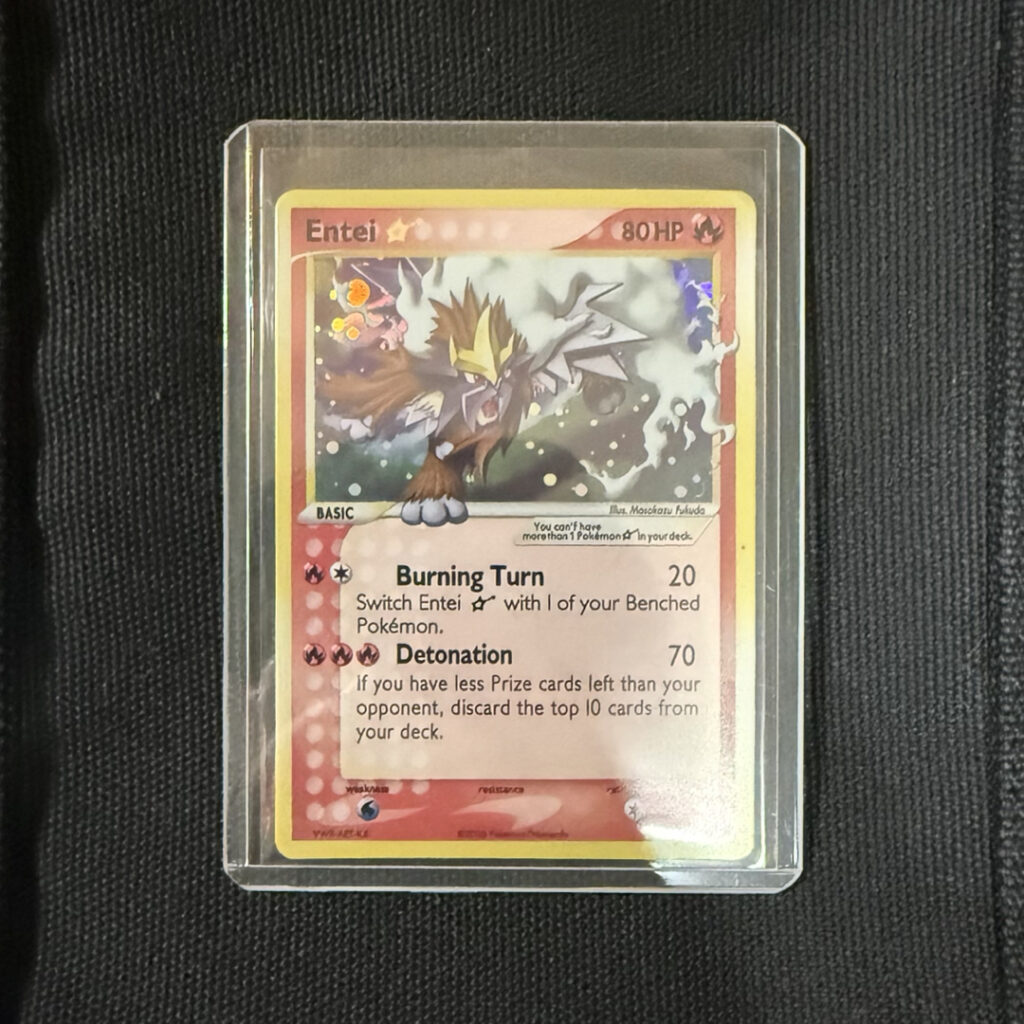
| EX Unseen Forces | 2005 | Entei ★ | 113/115 |
| EX Unseen Forces | 2005 | Raikou ★ | 114/115 |
| EX Unseen Forces | 2005 | Suicune ★ | 115/115 |
| EX Delta Species | 2005 | Groudon ★ | 111/113 |
| EX Delta Species | 2005 | Kyogre ★ | 112/113 |
| EX Delta Species | 2005 | Metagross ★ | 113/113 |
| EX Legend Maker | 2006 | Regice ★ | 90/92 |
| EX Legend Maker | 2006 | Regirock ★ | 91/92 |
| EX Legend Maker | 2006 | Registeel ★ | 92/92 |
| EX Holon Phantoms | 2006 | Gyarados ★ δ | 102/110 |
| EX Holon Phantoms | 2006 | Mewtwo ★ | 103/110 |
| EX Holon Phantoms | 2006 | Pikachu ★ | 104/110 |
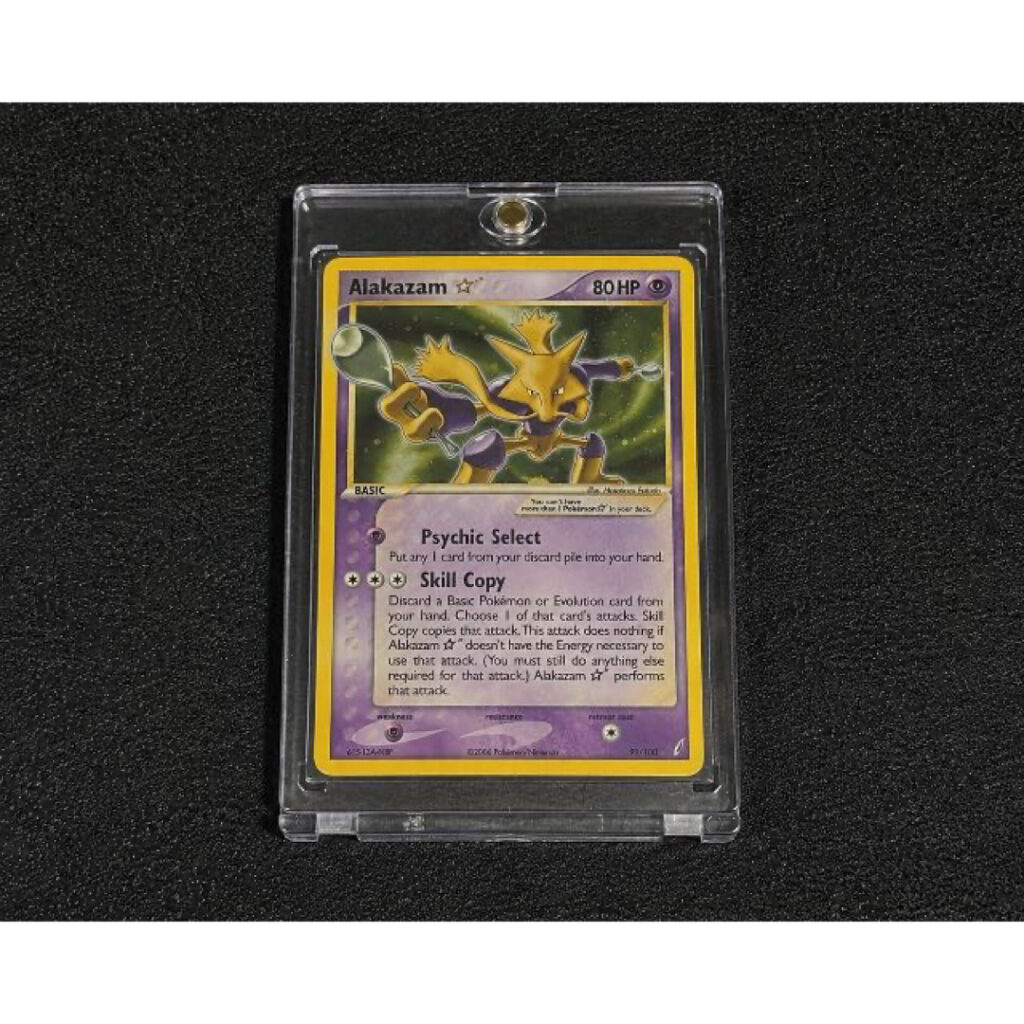
| EX Crystal Guardians | 2006 | Alakazam ★ | 99/100 |
| EX Crystal Guardians | 2006 | Celebi ★ | 100/100 |
| EX Dragon Frontiers | 2006 | Charizard ★ δ | 100/101 |
| EX Dragon Frontiers | 2006 | Mew ★ δ | 101/101 |
| EX Power Keepers | 2007 | Flareon ★ | 100/108 |
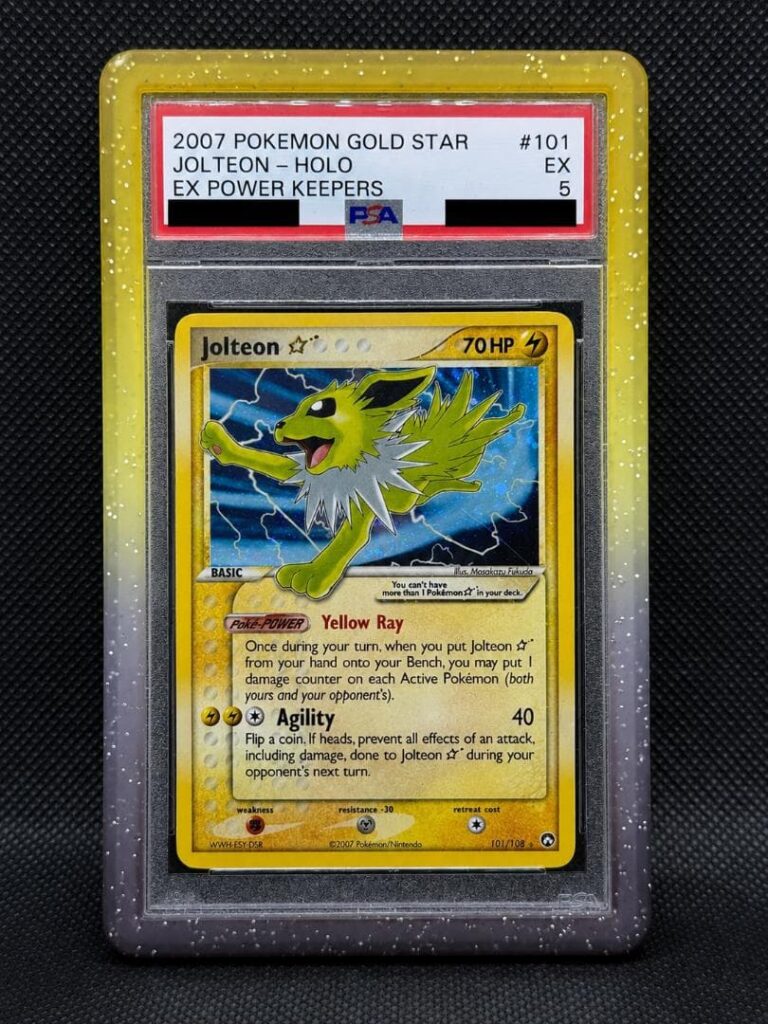
| EX Power Keepers | 2007 | Jolteon ★ | 101/108 |
| EX Power Keepers | 2007 | Vaporeon ★ | 102/108 |
| POP Series 5 | 2007 | Espeon ★ | 16/17 |
| POP Series 5 | 2007 | Umbreon ★ | 17/17 |
Umbreon and Espeon from POP Series 5
The last two cards in the run never appeared in a booster pack. POP Series 5 was distributed exclusively through the Pokémon Organized Play program for leagues and tournaments, which put it outside retail entirely. The set contained Espeon ★, numbered 16/17, and Umbreon ★, numbered 17/17, and it was released in March 2007.
That limited distribution helps explain their high prices. Far fewer copies entered circulation than did copies of the booster-pack Gold Stars, so both sit near the top of the market: Umbreon ★ is valued at about $160,000 in PSA 10 and Espeon ★ at about $73,100.
Gold Star Pokémon Cards That Are Not Part of the 27
A handful of cards use the Gold Star design without belonging to the English 27, which is why card counts differ between sources. Two groups sit outside the list:
- Japanese promos and the 2021 Greninja
- The single card that was reprinted
Japanese Promos and the Celebrations Greninja
You will see the total given as 27 in some places and 28 in others. The difference is whether Greninja ★ (SWSH144), a 2021 promo, is added to the English count; this guide keeps it separate.
Japan also had exclusive Gold Star promos distributed through membership and promotional programs. The Umbreon Gold Star from Japan’s Pokémon Player’s Club, numbered 26/PLAY, is the best-known example, and none of these belong to the English 27. They were distributed through several different channels, so this guide treats the example here as illustrative rather than exhaustive.
Copies rarely surface, and price databases that track the card by grade do not show enough completed sales to calculate a reliable average. Buying Japanese Gold Stars is covered later in this guide. Neokyo’s Japanese Pokémon TCG page is also linked below.
Neokyo’s Japanese Pokémon TCG page
Only One Gold Star Has Been Reprinted
Out of all 27 English cards, exactly one has ever been reprinted: Umbreon ★, which returned in the 2021 Celebrations: Classic Collection with the same Shiny artwork. Both versions carry the number 17/17 but fall into different price ranges — around $95 for the reprint versus roughly $4,640 for an ungraded POP Series 5 original. The rarity line makes the two versions easy to tell apart: if it reads Classic Collection, you have the 2021 card. The other 26 have never been reprinted, and the Pokémon ☆ rarity is no longer in use, so supply is fixed.
Both Umbreon Gold Stars are numbered 17/17. The 2021 Celebrations: Classic Collection version shows “Classic Collection” on its rarity line and sells for around $95. The 2007 POP Series 5 original has no such line and is worth about $4,640 ungraded. Check the rarity line before you agree to a price.
Gold Star Pokémon Card Prices and Recent Sales
Gold Star prices range from a few hundred dollars to well into six figures depending on the card and its grade. This section covers three things:
- Prices for all 27 cards by grade
- The 2026 auction results
- Where to check current numbers yourself
Gold Star Card Prices by Card and Grade
The table below compares every English Gold Star at four grade levels. The highest listed value is for a PSA 10 Latias ★ at about $375,000, with Rayquaza ★ close behind at about $366,000.
At the other end, the least expensive ungraded card is Regice ★ at about $703, and the least expensive PSA 10 is Groudon ★ at about $13,200. If you want an original Gold Star without spending five figures, the six least expensive cards come from EX Legend Maker and EX Unseen Forces, all between about $703 and $1,100 ungraded.
Cheaper still are the two 2021 designs: Greninja ★ at about $29.60 and the Umbreon ★ reprint at about $86. Neither belongs to the EX-era 27, so make sure you know which version you are buying. Beyond the specific card, grade is one of the biggest drivers of value, and the jump from Grade 9 to PSA 10 is by far the largest price increase.
| Card (set, number) | Ungraded | Grade 8 | Grade 9 | PSA 10 |
| Mudkip ★ (EX Team Rocket Returns 107/109) | $3,050 | $11,300 | $11,600 | $13,900 |
| Torchic ★ (EX Team Rocket Returns 108/109) | $2,830 | $12,500 | $15,600 | $63,500 |
| Treecko ★ (EX Team Rocket Returns 109/109) | $2,560 | $5,890 | $9,970 | $32,800 |
| Latias ★ (EX Deoxys 105/107) | $1,440 | $8,600 | $15,500 | $375,000 |
| Latios ★ (EX Deoxys 106/107) | $1,440 | $6,170 | $9,070 | $32,800 |
| Rayquaza ★ (EX Deoxys 107/107) | $11,800 | $39,100 | $82,000 | $366,000 |
| Entei ★ (EX Unseen Forces 113/115) | $1,010 | $1,530 | $2,180 | $15,000 |
| Raikou ★ (EX Unseen Forces 114/115) | $990 | $1,510 | $2,420 | $13,500 |
| Suicune ★ (EX Unseen Forces 115/115) | $1,100 | $1,860 | $2,440 | $13,500 |
| Groudon ★ (EX Delta Species 111/113) | $1,280 | $3,600 | $5,030 | $13,200 |
| Kyogre ★ (EX Delta Species 112/113) | $1,410 | $4,250 | $6,020 | $40,400 |
| Metagross ★ (EX Delta Species 113/113) | $1,390 | $4,810 | $6,290 | $26,500 |
| Regice ★ (EX Legend Maker 90/92) | $703 | $2,510 | $2,870 | $17,500 |
| Regirock ★ (EX Legend Maker 91/92) | $1,080 | $1,720 | $3,390 | $14,600 |
| Registeel ★ (EX Legend Maker 92/92) | $886 | $1,930 | $2,760 | $19,200 |
| Gyarados ★ δ (EX Holon Phantoms 102/110) | $2,110 | $6,630 | $13,500 | $80,500 |
| Mewtwo ★ (EX Holon Phantoms 103/110) | $1,810 | $10,300 | $15,600 | $78,100 |
| Pikachu ★ (EX Holon Phantoms 104/110) | $3,480 | $12,500 | $19,300 | $112,000 |
| Alakazam ★ (EX Crystal Guardians 99/100) | $1,180 | $3,800 | $5,740 | $16,100 |
| Celebi ★ (EX Crystal Guardians 100/100) | $751 | $2,990 | $4,470 | $17,300 |
| Charizard ★ δ (EX Dragon Frontiers 100/101) | $3,430 | $15,100 | $31,300 | $151,000 |
| Mew ★ δ (EX Dragon Frontiers 101/101) | $2,000 | $8,250 | $12,600 | $86,600 |
| Flareon ★ (EX Power Keepers 100/108) | $1,190 | $3,200 | $4,180 | $29,000 |
| Jolteon ★ (EX Power Keepers 101/108) | $1,050 | $2,400 | $4,470 | $31,100 |
| Vaporeon ★ (EX Power Keepers 102/108) | $1,140 | $3,400 | $4,430 | $26,400 |
| Espeon ★ (POP Series 5 16/17) | $5,180 | $15,000 | $15,400 | $73,100 |
| Umbreon ★ (POP Series 5 17/17) | $4,640 | $18,100 | $23,400 | $160,000 |
| Umbreon ★ (Celebrations: Classic Collection 17/17, 2021 reprint) | $86 | — | $116 | $395 |
| Greninja ★ (SWSH144, 2021 promo) | $29.60 | — | $71 | $1,780 |
Approximate market values as of August 27, 2026, via PriceCharting and TCGplayer.
Record Sales in 2026
Several major sales in August 2026 showed how high the top end of the Gold Star market has climbed. ComicBook.com reported that five Gold Stars sold in a single Fanatics Collect Weekly Auction that month.
Two PSA 10 copies of Treecko ★ led at $132,000 and $114,000, followed by a PSA 10 Japanese PLAY promo Flareon ★ at $60,000, Rayquaza ★ in PSA 6 at $43,200, and Mew ★ in PSA 9 at $19,800. All five sale prices were still below the roughly $375,000 value shown for a PSA 10 Latias ★.
Where to Check Current Prices
Prices change over time, so check current market data yourself before buying. For English cards, PriceCharting shows values from ungraded through PSA 10 alongside a dated sales history, and TCGplayer shows the market price, the most recent sale, how many copies are available, and how many sellers currently have them listed. PSA publishes its own auction results, but the Auction Prices Realized database now requires a free account.
Japanese listings need Japanese sources. Yahoo Auctions provides completed-auction data covering the past 180 days: a search for “ポケモンカード ゴールドスター” returned 40 results with a low of ¥8,000, an average of about ¥176,000, and a high of about ¥491,000. Those search results mix English and Japanese cards across a wide range of conditions, so read the figures as a range rather than a benchmark. On Mercari, filtering for sold listings shows what buyers paid.
Valuing an individual card takes one more step. Search by card name and number — Umbreon 17/17, for example — filter to completed listings, then compare only against copies in the same version, condition, and grade. Every price in this guide was checked on August 27, 2026, so look up the current figure at one of these sources before you commit.
Why Gold Star Pokémon Cards Are So Rare
Two forces explain the price levels above: how rarely these cards were pulled from packs, and how rarely high-grade copies come up for sale.
- Pull rates in the original expansions
- How few PSA 10 copies reach the market
Pull Rates of About One Gold Star per Two Booster Boxes
Gold Star pull rates are widely reported as roughly one card per 72 packs. That estimate comes from collector reports rather than official data, because The Pokémon Company has never published pull rates for English packs.
Booster boxes of that era typically held around three dozen packs, which works out to roughly one Gold Star per two booster boxes. EX Power Keepers is reported by collectors as an exception, with Gold Stars appearing noticeably more often.
Pulling a specific card was harder still. Each expansion carried two or three different Gold Stars, so the odds of pulling the one you wanted were even lower.
PSA 10 Copies Almost Never Come Up for Sale
Sales frequency tells the story better than any population figure. PSA 10 copies of many major Gold Stars sell only one to three times a year, while ungraded copies of the same cards change hands several times a week.
That scarcity shows up directly in price. On PriceCharting as of August 27, 2026, Rayquaza ★ is worth about $82,000 in Grade 9 and about $366,000 in PSA 10, a more than fourfold increase for a single grade step. PSA’s own population data now requires a free account to view, so sales frequency is a more practical way to gauge how often high-grade copies reach the market.
Where to Buy Gold Star Pokémon Cards
Where you shop depends on which version you want, because English and Japanese copies tend to be concentrated in different marketplaces.
- International marketplaces for English cards
- Why many Japanese listings are hard to buy from overseas
- Using a proxy service to reach them
English Gold Stars on International Marketplaces
English Gold Stars turn up regularly on TCGplayer and eBay, with dozens of active listings for the more common cards at any given time. The highest-value copies are more likely to appear at major auction houses: Fanatics Collect handled the August 2026 sales covered earlier, and comparable cards appear in similar sales throughout the year.
Buying a graded, slabbed copy gives you the benefit of third-party authentication. At higher price points, that is one of the simplest ways to reduce authentication risk.
Japanese Gold Stars Are Listed Inside Japan
There are two reasons to look at the Japanese market. Japanese-exclusive Gold Stars, such as the PLAY promos, are found primarily on Japanese marketplaces, and English cards listed domestically in Japan may carry less markup than the same card sold through an international reseller.
The main obstacle is that many Japanese sellers only ship domestically. Mercari’s own guidance states that sellers send items to a designated address inside Japan and are not required to ship abroad.
Living outside Japan also means you cannot simply use these platforms. Mercari states that overseas customers cannot use the service directly, so overseas purchases may need to go through an intermediary, which handles international forwarding and the export process rather than the original seller. You can still find those listings, but you may not be able to purchase from them directly.
Further reading: Why Are Japanese Pokémon Cards Cheaper?
Buying Japanese Listings Through a Proxy Service
A proxy service closes that gap. Neokyo describes itself as an intermediary service for purchases in Japan: it buys on your behalf, receives the item at a Japanese address, and forwards it on. It covers Mercari, JDirectItems Auction, Surugaya, Rakuma, Rakuten, and Amazon Japan, among other Japanese marketplaces, and the process works in five steps.
- Check shipping, then find the card. Confirm that Neokyo ships to your destination before choosing a listing on a Japanese marketplace.
- Request the purchase. Submit the item URL and confirm the order; the service handles contact with the seller.
- Use the free storage period if needed. Purchases include 45 days of free warehouse storage, which lets you group several cards into one shipment, and weekly storage fees start once that period ends.
- Request packing. The packing fee starts at ¥500 for shipments up to 2kg, then ¥150 for each additional kilogram.
- Choose international shipping. Six methods are offered, and Neokyo does not add a markup to the carrier’s own rate.
Neokyo charges ¥350 per item, plus a packing fee. The item price, domestic shipping within Japan, international shipping, and any import duties on your end are separate.
What a proxy service does not do is verify authenticity. Neokyo states that claims or refunds are not available if an item turns out to be inauthentic or does not match its description, and that it will not contact the seller for you if a problem arises.
That puts the checks back on you. Read the description closely, since Neokyo’s own guidance notes that images on private marketplaces are not always accurate. Favor professional retailers over individual sellers and consider a graded copy for higher-value cards, because you may not be able to get reliable answers about authenticity from the seller.
Confirm shipping coverage first. Surface, Airmail, EMS, FedEx, UPS, and DHL are all offered, but not every method reaches every country, so check your destination in the shipping estimator before you commit.
Start buying Japanese Pokémon TCG listings with Neokyo
Gold Star Pokémon Cards: What to Check Before You Buy
Before you buy, run through these six checks.
Confirm the version. Match the set name and card number: Umbreon 17/17 exists as both a $4,640 original and a $95 reprint.
Assess authenticity. Work through the star position, holo pattern, and print quality, and consider buying a graded copy for higher-value cards — a proxy service will not verify the card for you.
Check the grade. The jump from Grade 9 to PSA 10 is often the largest price increase between adjacent grades, so know which one you are paying for.
Check the current market price yourself. Use PriceCharting and TCGplayer for English cards, and completed listings on Yahoo Auctions or sold listings on Mercari for Japanese cards. In either case, filter for the same version and grade.
Add up the full cost. Item price, domestic shipping within Japan, the ¥350 service fee, packing from ¥500, international shipping, and any import duties.
Confirm that shipping is available to your destination. Not every shipping method reaches every country, so check before you buy rather than after.
Once you have checked those six points, you can focus on finding the Gold Star you want.