

Pokémon Card Rarity List | How to Read Symbols and the Meaning of AR, SAR, SR, and MUR (Japanese Version Standard)
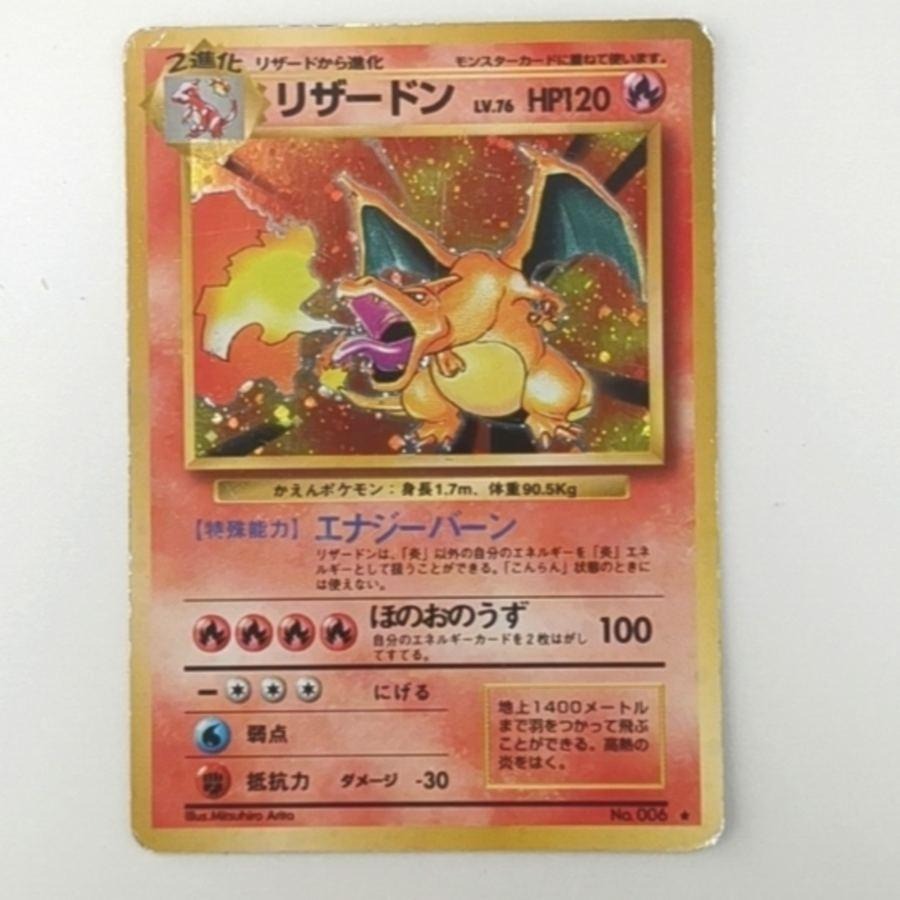
Old-back Charizard (1996 first expansion)
The rarity of a Pokémon card can be identified by the code or letter at the bottom left of the card. However, the notation system differs between Japanese and English versions, and new rarities are added with each series. This article explains the quick reference table for the Japanese version (MEGA Series) as of 2026, the correspondence with English symbols, the meaning of each rarity, and rarities from past series. Note that card “types” (Pokémon, Trainers, Energy) and “rarities” are separate concepts; this article addresses rarity only.
Quick Reference Table for Japanese Pokémon Card Rarities (2026 MEGA Series)
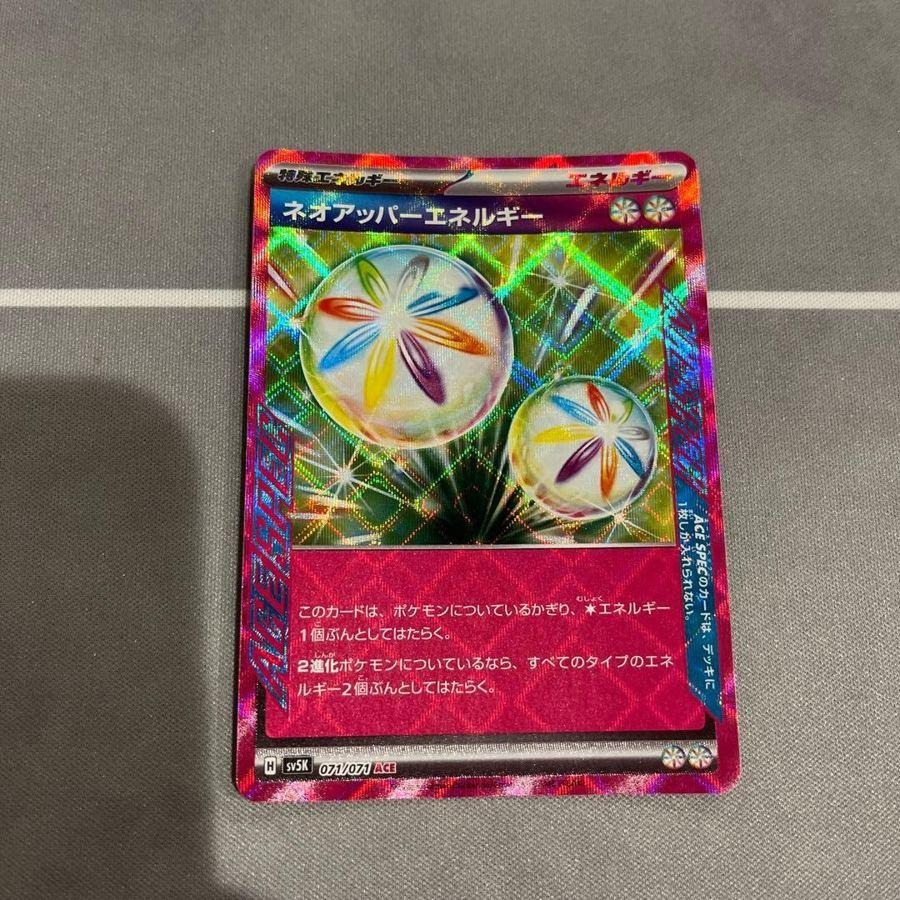
Example of ACE (ACE SPEC): Neo Upper Energy (071/071)
The following table lists the main rarity notations used in current products. Because pull rates and positioning vary by product, the order presented in the table does not reflect an official rarity ranking.
| Notation | Name | Visual Characteristics |
|---|---|---|
| MUR | Mega Ultra Rare | Gold-themed exclusive illustration. Introduced in the MEGA Series |
| UR | Ultra Rare | Full gold foil finish. Also applies to Trainers and Energy |
| SAR | Special Illustration Rare | Full-bleed artwork extending past the frame, textured finish |
| MA | Mega Attack Rare | Represents scenes of unleashing powerful attacks with special artwork. Introduced in the MEGA Series |
| SR | Super Rare | Full-art specification for Pokémon ex and Supporters |
| ACE | ACE SPEC | Deck-limit-1 Trainers. Exclusive design |
| AR | Art Rare | Full-bleed artwork version of regular Pokémon |
| RR | Double Rare | Standard-design Pokémon ex |
| R | Rare | Foil-finished card |
| U | Uncommon | Non-foil |
| C | Common | Non-foil. Most frequently inserted |
MUR and MA are new rarities introduced in the MEGA Series, appearing in expansion packs and High-Class packs. However, because they are not included in every MEGA-related product, verify whether a specific product contains them by checking its official card list.
Where Is the Rarity Notation Located?
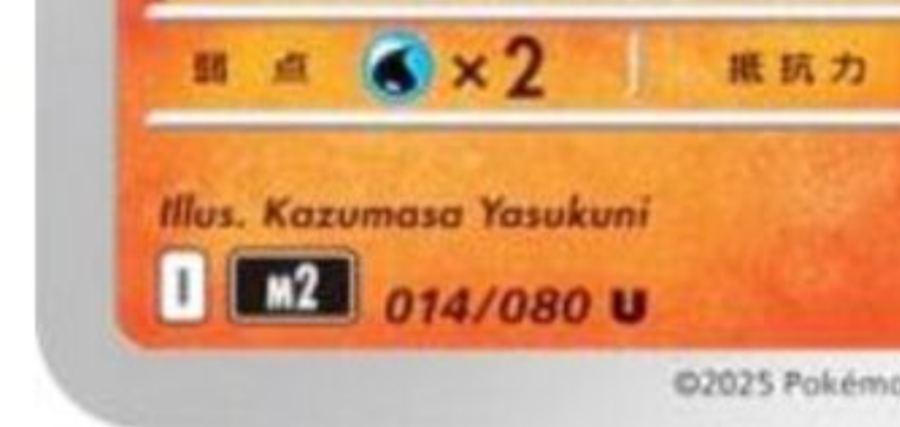
Bottom-left of a card: regulation mark, expansion mark (m2), collection number (014/080) and rarity (U)
On Japanese cards, the rarity notation is located at the bottom left of the card, lined up alongside the regulation mark, expansion mark (the set symbol, e.g., m6), and collection number (e.g., 110/076). A common point of confusion is mixing up the expansion mark with the rarity; the former merely indicates “which set” the card belongs to and has no bearing on rarity. Furthermore, in modern Japanese sets, when a card number exceeds the set’s standard card count (e.g., 110/076), it often indicates that the card belongs to the Secret slot. Always confirm the exact rarity using the notation at the bottom left.
Correspondence Table Between Japanese and English Rarities
The Japanese version uses abbreviations, whereas the English version uses symbols and English names. When reading overseas market information, use the following correspondence table:
| Japanese | English Name | English Symbol |
|---|---|---|
| C | Common | ● (Black Circle) |
| U | Uncommon | ◆ (Black Diamond) |
| R | Rare | ★ (Single Black Star) |
| RR | Double Rare | ★★ (Two Black Stars) |
| AR | Illustration Rare (IR) | ★ (Single Gold Star) |
| SR | Ultra Rare | ★★ (Two Silver Stars) |
| SAR | Special Illustration Rare (SIR) | ★★ (Two Gold Stars) |
| UR | Hyper Rare | ★★★ (Three Gold Stars) |
| ACE | ACE SPEC Rare | ★ (Magenta Star) |
| MA | Mega Attack Rare | Pink and Green Star |
| MUR | Mega Hyper Rare | — (Exclusive Notation) |
In the English version, “SAR” is generally abbreviated as “SIR” and “AR” as “IR.” In English sets from Scarlet & Violet onward, rarity is expressed by symbol shapes and star colors/counts. The ●, ◆, and ★ symbols have long been used as basic rarity markers, with current cards adding distinctions via star color and count. Earlier eras used different symbol systems. Note that a Reverse Holo (foil background only) Common is still classified as a Common.
Meanings of Each Rarity in the Current MEGA Series
Market prices serve as rough estimates based on Card Rush published prices (buy/sell) in late August 2026 (August 22–30) and fluctuate significantly based on popularity and condition.
C (Common)
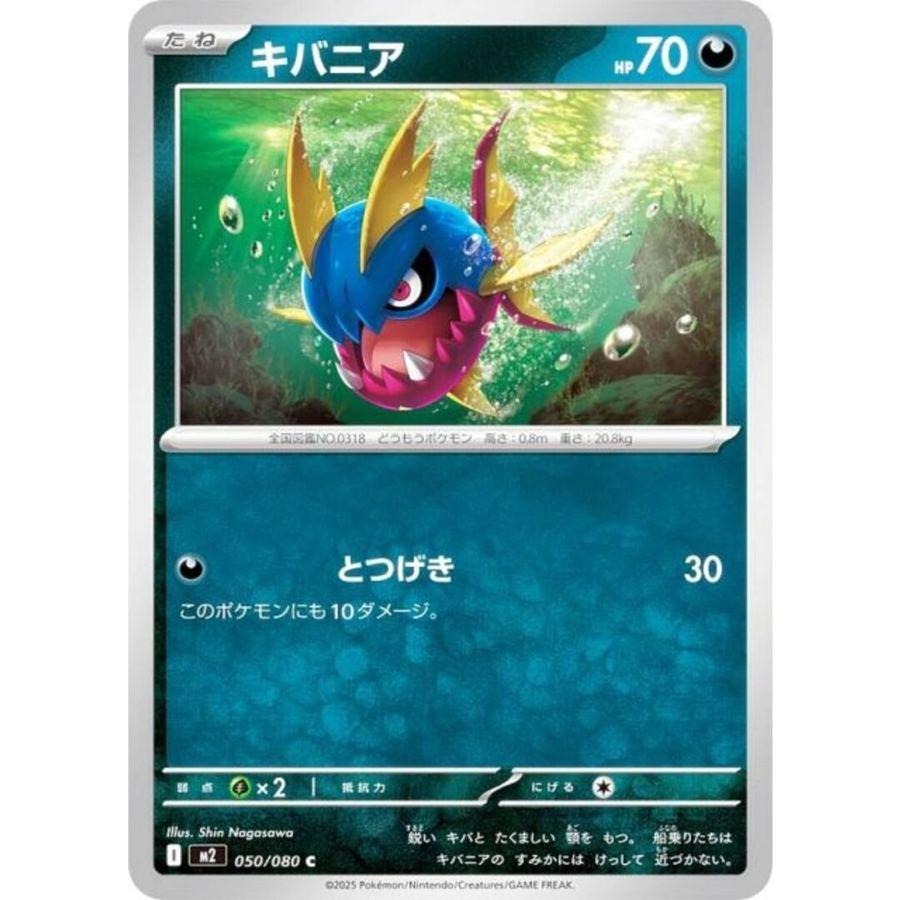
Example of C (Common): Carvanha
Non-foil cards inserted most frequently. Centered on Basic Pokémon and basic Item cards; standalone trade value is virtually non-existent.
U (Uncommon)
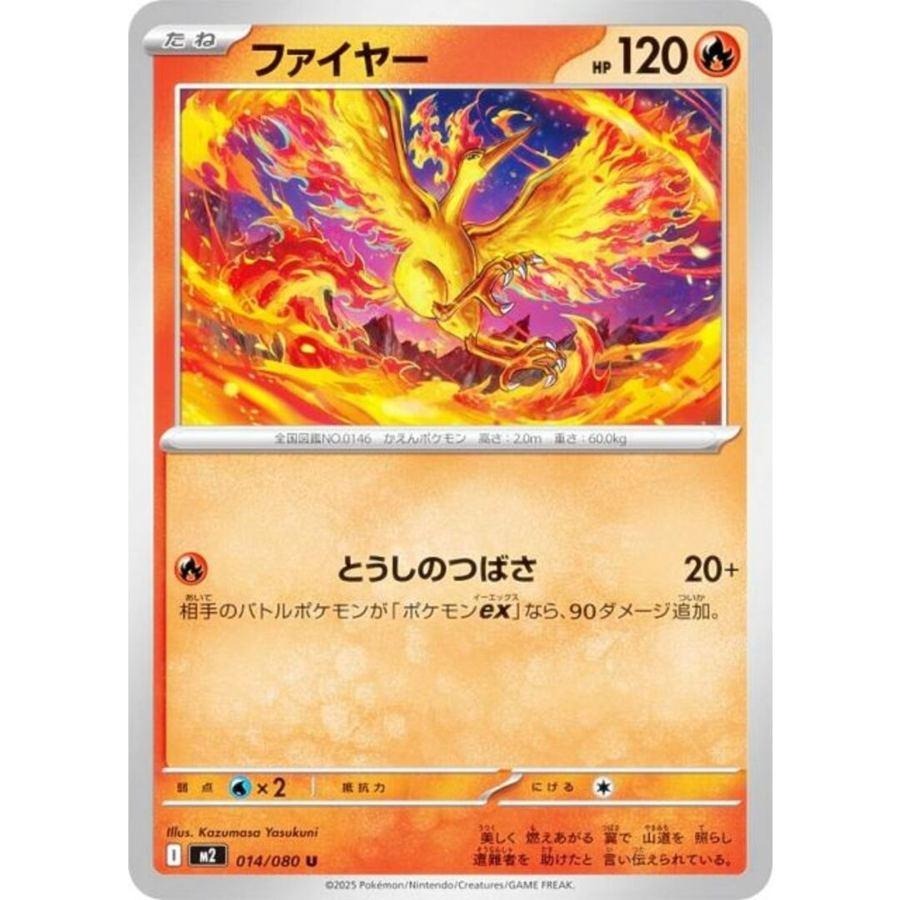
Example of U (Uncommon): Moltres
Non-foil cards scarcer than Commons. Common for Stage 1 Pokémon and Supporters; unit prices are around a few dozen yen.
R (Rare)
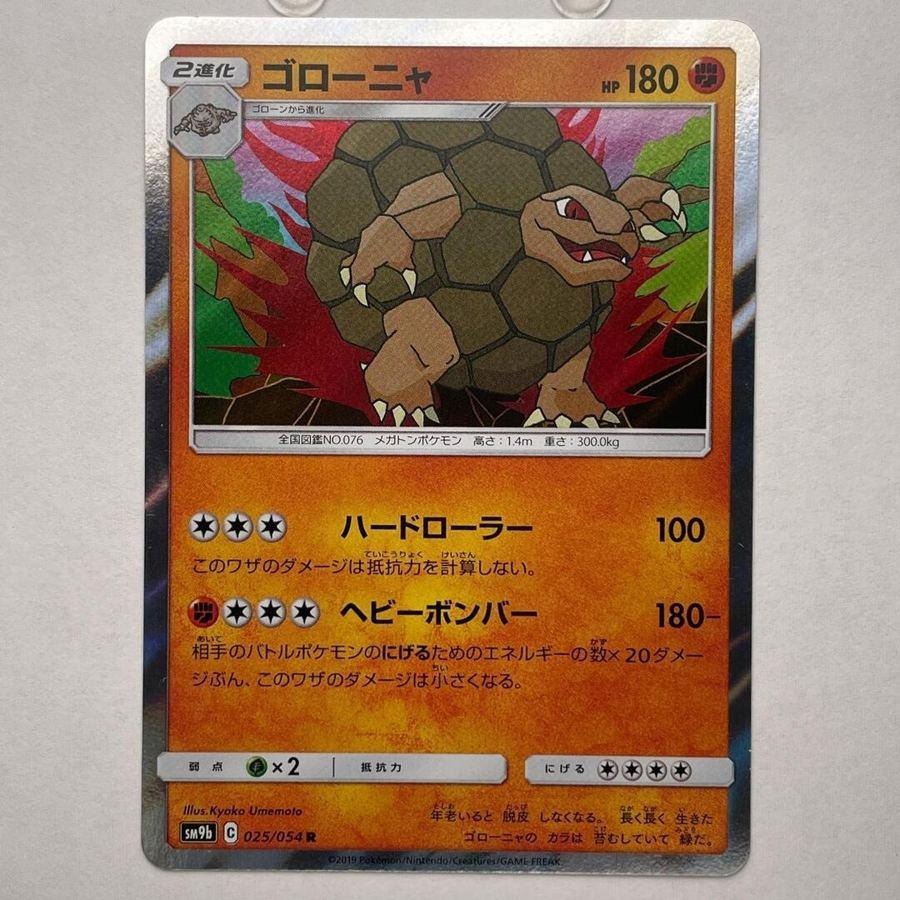
Example of R (Rare): Golem
Foil-finished cards, including evolved Pokémon and powerful Trainers. Market prices center between a few dozen to a few hundred yen (e.g., Storm Emeralda R sells for ¥80).
RR (Double Rare)
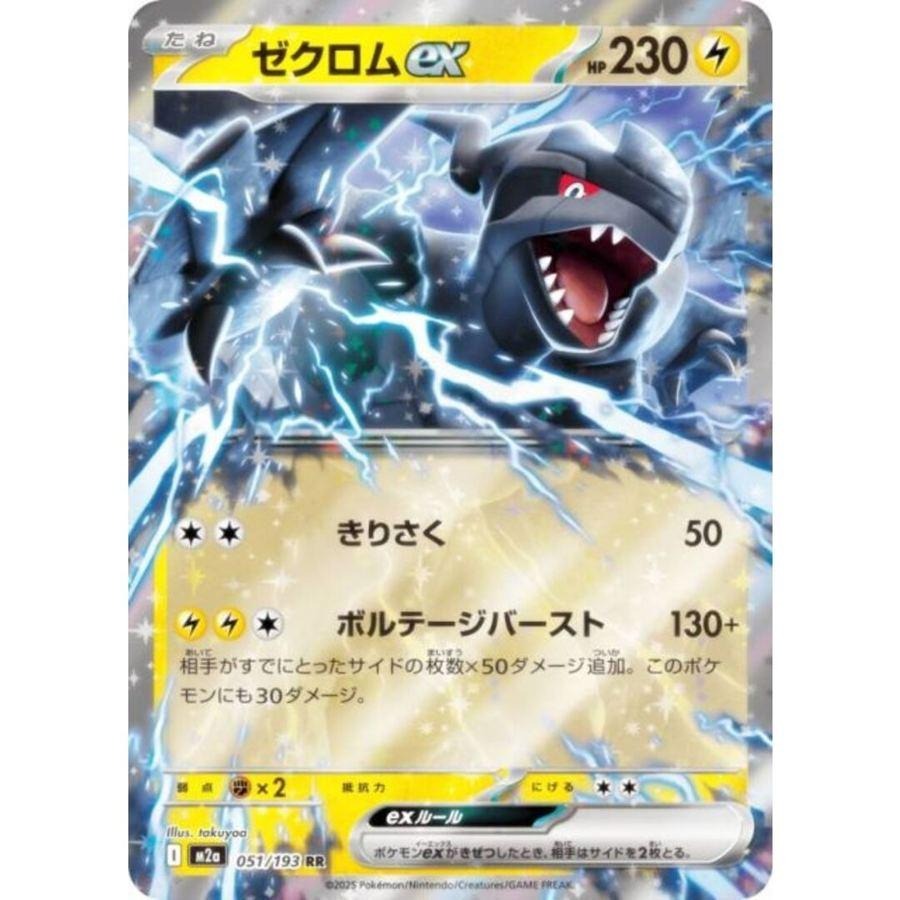
Example of RR (Double Rare): Zekrom ex
Standard-design Pokémon ex. Most sell for a few hundred yen or less, though cards used heavily in competitive play trade higher (e.g., Storm Emeralda RR sells between ¥120 and ¥780).
AR (Art Rare)
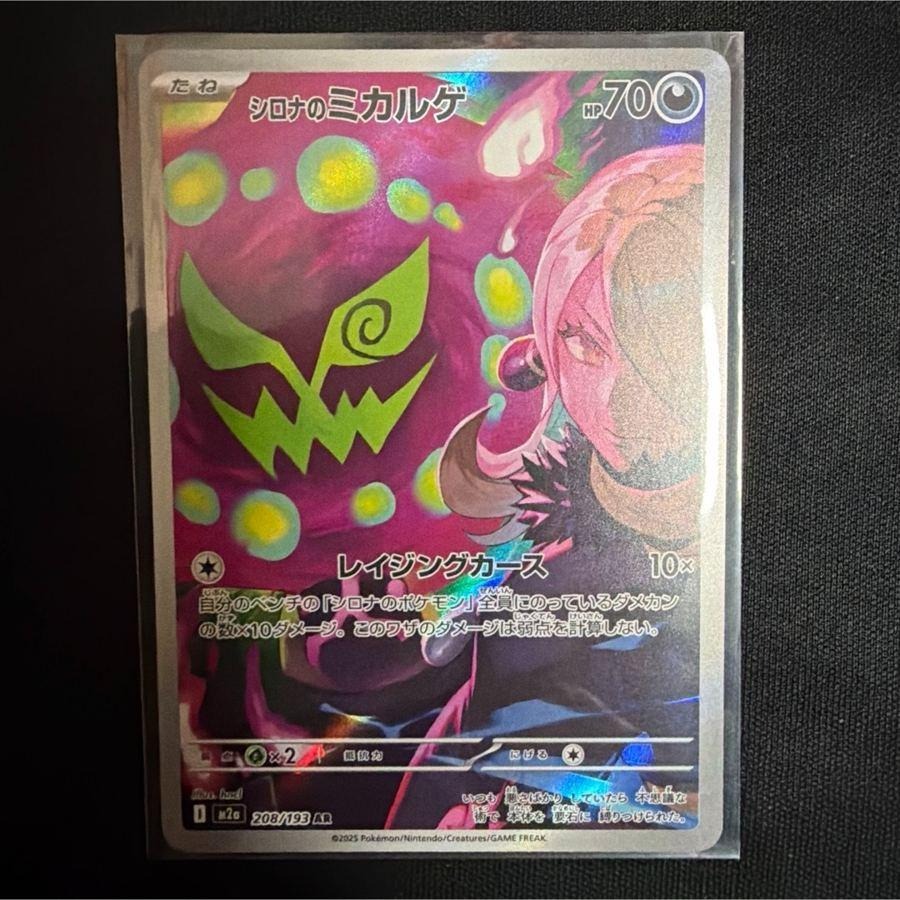
Example of AR (Art Rare): Cynthia’s Spiritomb
Full-bleed artwork versions of non-ex regular Pokémon. Highly popular among collectors, market prices center between a few hundred to a few thousand yen (e.g., Storm Emeralda AR sells between ¥480 and ¥1,780).
SR (Super Rare)
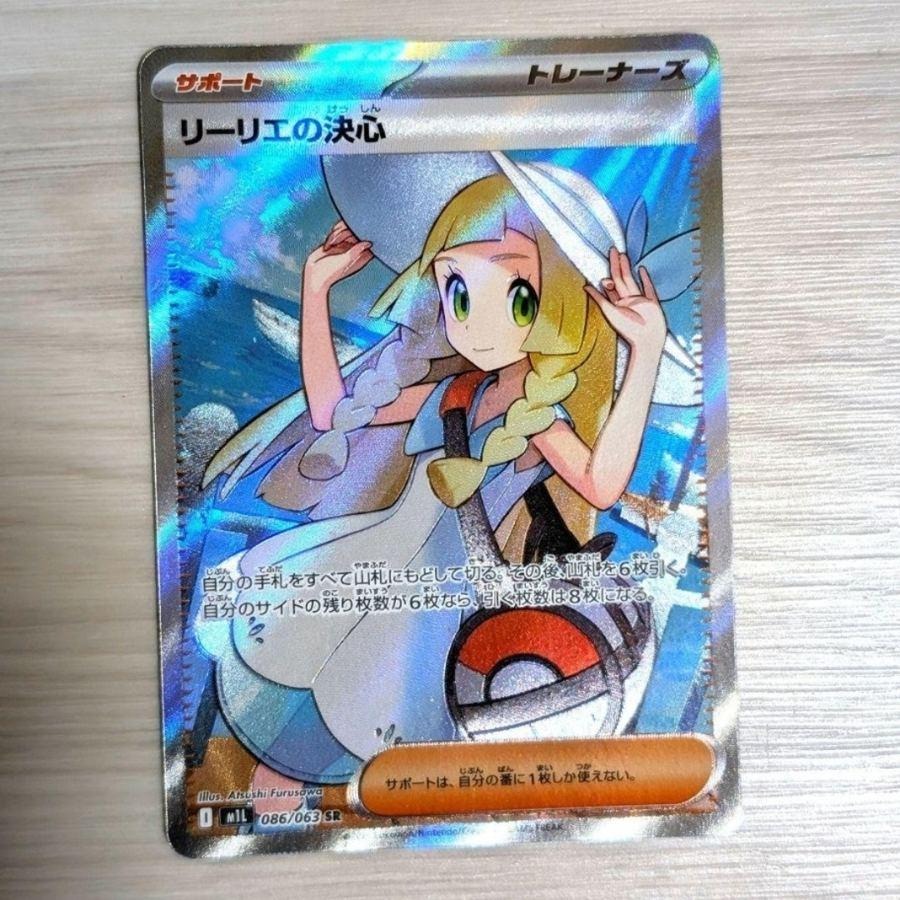
Example of SR (Super Rare): Lillie’s Determination
Full-art versions of Pokémon ex and Supporters. Market prices center between a few hundred to a few thousand yen (e.g., Storm Emeralda SR sells between ¥280 and ¥4,580).
SAR (Special Illustration Rare)
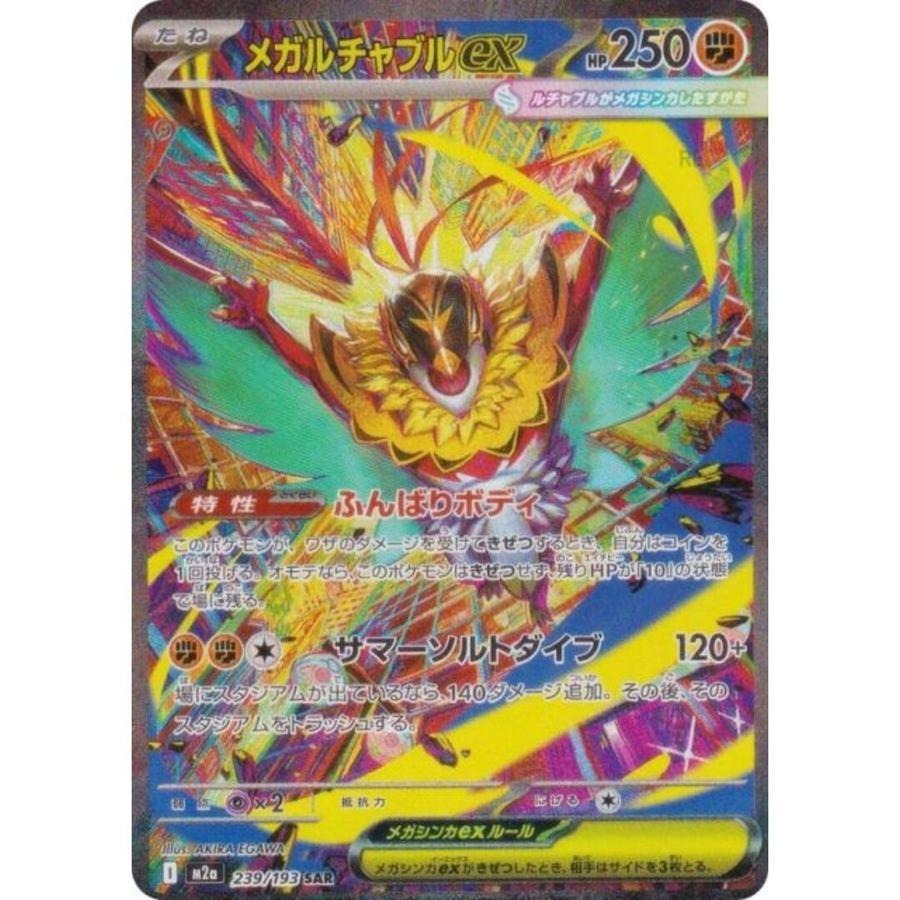
Example of SAR (Special Illustration Rare): Mega Hawlucha ex
Full-bleed artwork versions of Pokémon ex and Supporters featuring textured finishes. Market prices span broadly from several thousand to tens of thousands of yen, with SARs of popular Pokémon reaching buyback values of ¥50,000 to ¥80,000 (e.g., Umbreon ex SAR, Mew ex SAR).
UR (Ultra Rare)
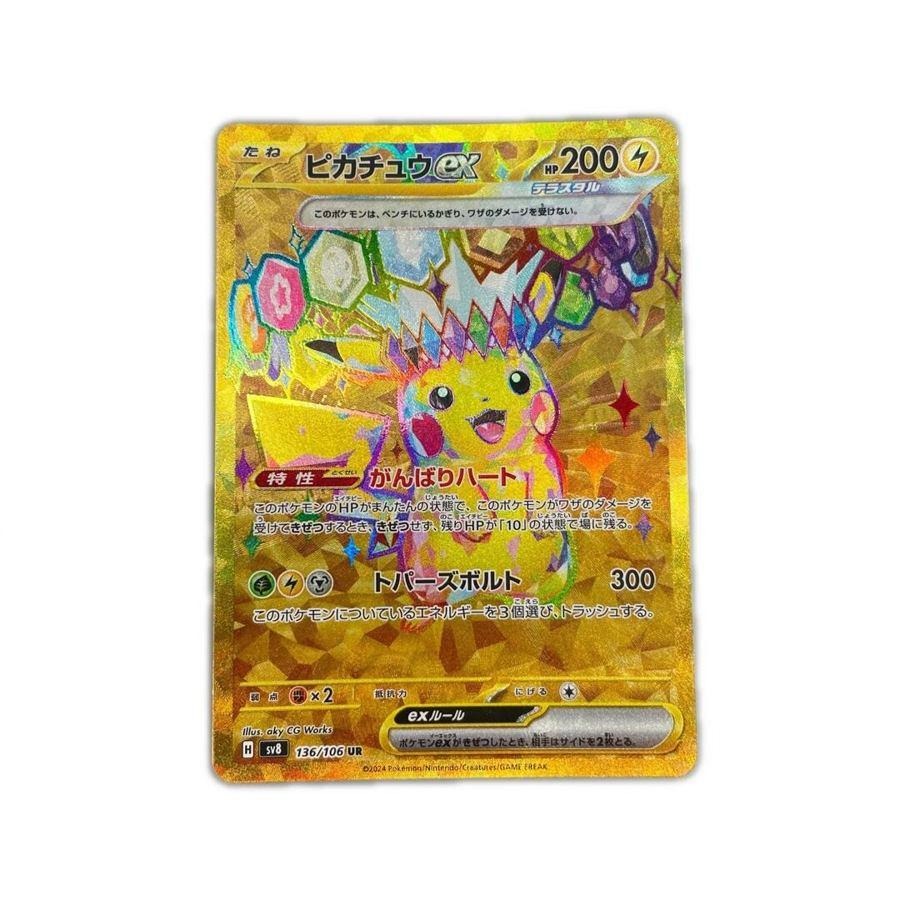
Example of UR (Ultra Rare): Pikachu ex
Cards with full gold foil finishes. Applies not only to Pokémon but also to Trainers and Energy cards.
MUR (Mega Ultra Rare)
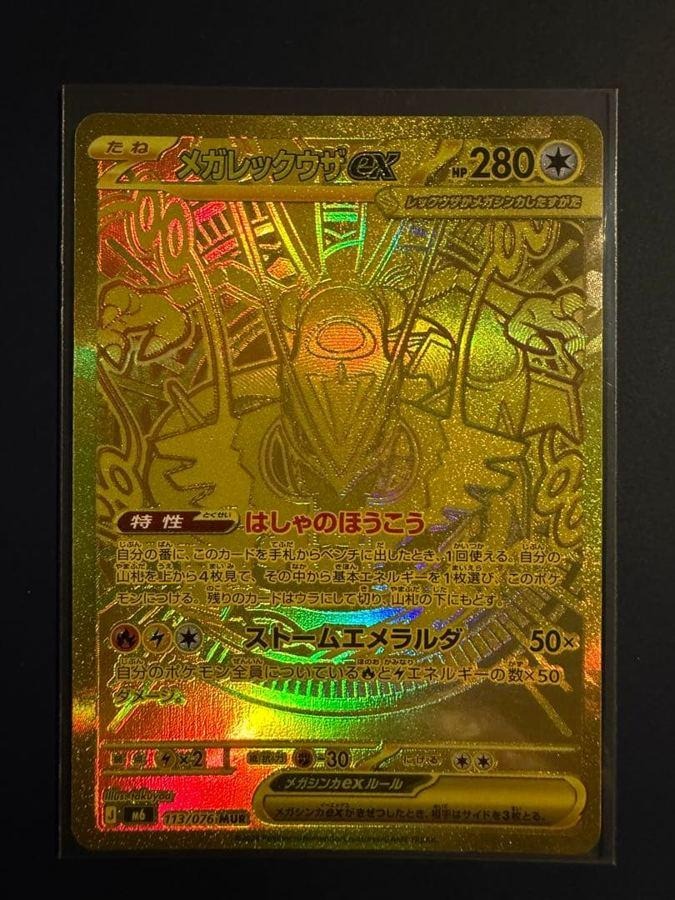
Example of MUR (Mega Ultra Rare): Mega Rayquaza ex (Storm Emeralda 113/076)
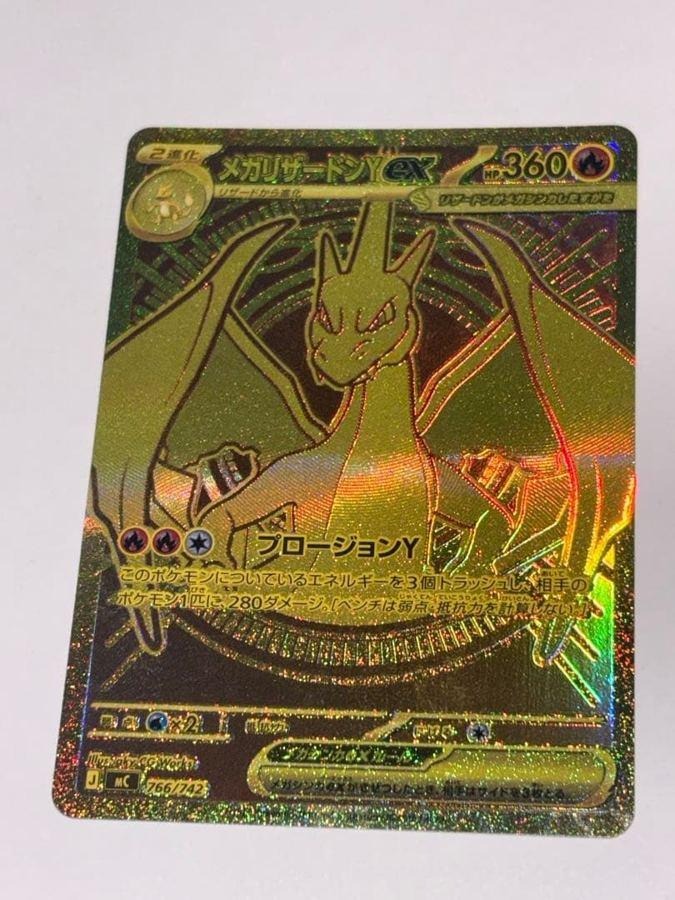
The “MUR-spec” Mega Charizard Y ex (766/742, Start Deck 100 Battle Collection) — treated separately from booster-pack MURs
A rarity that debuted in August 2025 with “Mega Brave” and “Mega Symphonia,” with the initial cards being Mega Lucario ex and Mega Gardevoir ex. Characterized by a gold-themed design featuring exclusive artwork. As of August 2026, 9 MUR-related card types have been confirmed. However, among them, Mega Charizard Y ex (766/742) was included as an “MUR specification” inside a pre-constructed deck product (Start Deck 100 Battle Collection) and is distinguished from standard MURs pulled from expansion booster packs. Expansion booster pack MURs trade roughly between tens of thousands to ¥200,000+ as of August 2026; retail listings exceeding ¥1,000,000 can be observed for the MUR-spec Mega Charizard Y ex, though prices vary vastly based on card condition, grading tier, and sales format.
MA (Mega Attack Rare)
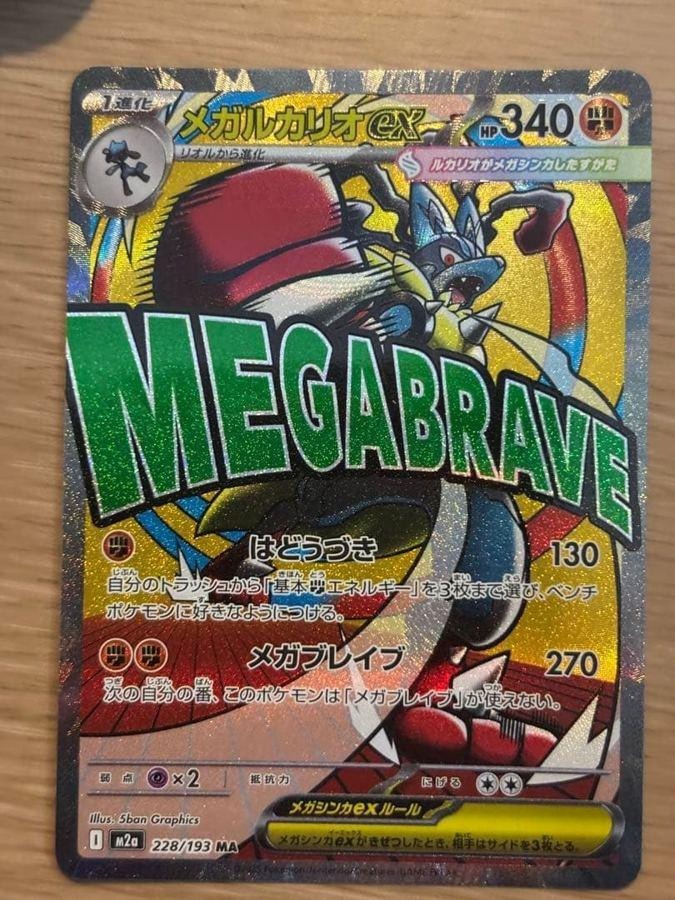
Example of MA (Mega Attack Rare): Mega Lucario ex (MEGA Dream ex 228/193)
A rarity introduced in the High-Class Pack “MEGA Dream ex” released on November 28, 2025. It depicts scenes of Pokémon unleashing powerful attacks with special artwork.
Rarities from Past and Specific Series
The following table showcases representative rarities used only in past series or specific expansions that are not included in current sets:
| Notation | Name | Period Used & Characteristics |
|---|---|---|
| RRR | Triple Rare | Primarily VMAX and VSTAR during the Sword & Shield era |
| HR | Hyper Rare | Sun & Moon era through Sword & Shield era. Rainbow foil finish |
| K | Radiant (Kagayaku) | “Radiant Pokémon” during the Sword & Shield era |
| CHR | Character Rare | Introduced in Sun & Moon, also used in Sword & Shield. Depicts Pokémon together with Trainers |
| CSR | Character Super Rare | Primarily Sword & Shield era. Higher tier of CHR |
| SSR | Shiny Super Rare | Select High-Class Packs in Sun & Moon and Sword & Shield. Shiny Pokémon |
| BWR | (Set Specific) | Representative example of a rarity exclusive to a specific set |
Note that in the 1st Japanese Expansion Pack released in 1996, select initial printings lacked rarity symbols at the bottom right, commonly referred to as “No Rarity.” This identification method cannot be applied to all Old Back (Kyu-back) cards. For details, refer to our guide on identifying First Edition Pokémon cards.
Pull Rates: Differences Between Official Values and Observed Values
Pull rates are not officially published by The Pokémon Company; figures found online represent observed and estimated values compiled by card shops and collectors from unboxing results.
As a general guideline, a single current expansion booster box contains a few RRs, a few ARs, and a few SRs, while it is not uncommon for a box to contain no SAR at all. MUR pull rates are even lower; for reference, an unboxing survey of the English “Mega Evolution” set by TCGplayer observed Mega Hyper Rares at approximately 1 in every 1,260 packs. This is an observed value for that specific product, not an official pull rate or a universal figure across other sets. Because pack configurations differ fundamentally between expansion booster packs and High-Class packs, check unboxing reports for each specific product before purchasing.
How to Identify Rare Cards
- Read the Rarity Notation at the Bottom Left: Check whether it is C, U, R, RR, AR, SR, SAR, UR, MA, or MUR. This completes most of the identification.
- Examine the Collection Number: If it exceeds the standard card count of the set, it is typically a Secret card slot.
- Inspect the Surface Finish: Full-bleed artwork, textured finishes, and gold finishes are signs of high rarity.
- Identify the Expansion Set: Identify the set via the expansion mark and cross-reference it with the official set list.
Steps 2 through 4 serve as supporting methods when notations are faded or when inspecting vintage series cards.
High Rarity Does Not Always Equal High Price
Rarity indicates “insertion scarcity,” not market price. Prices are primarily driven by Pokémon and character popularity, card condition, grading status, and reprint/restock availability. While an R card of a popular character from a vintage series can command a high price, SR cards that can be bought for a few hundred yen are quite common. Always evaluate cards by checking rarity first, followed by popularity and condition.
Seller Condition Grades (A, B, C) Are Not Rarities
Japanese card shops and flea market listings often denote card conditions using grade ranks such as “A,” “B,” or “C.” These describe physical condition (degree of scratches or edge whitening) and are completely unrelated to card rarity.
Search Terms When Looking for Rare Cards in Japan
Combining rarity abbreviations with Japanese card names is most effective:
- (Pokémon Name) SAR
- (Pokémon Name) AR
- (Pokémon Name) MUR
- ポケカ SAR 美品 (Pokéca SAR Mint Condition)
- ポケカ PSA10 (Pokéca PSA 10)
- (Set Name) シークレット (Set Name Secret)
Because English abbreviations like “IR” or “SIR” are rarely used in Japanese listing titles, search using Japanese market notations.
Frequently Asked Questions (FAQ)
Q. Which products contain MUR cards?
MUR cards appear in select expansion booster packs and High-Class packs in the MEGA Series, but they are not included in every MEGA product. Check the official card list for each product.
Q. Which is rarer: SAR or UR?
Whether UR or SAR is harder to pull varies by product, and no universal official pull rate is published. Furthermore, market prices depend heavily on Pokémon and illustration popularity rather than pull rates alone.
Q. Are RRR, HR, and CHR cards still included in new packs?
No. These are rarities from past series that are not included in the current MEGA Series.
Search for Japanese Rare Cards on Neokyo
Japanese Pokémon cards circulate most abundantly on Japanese domestic marketplaces such as Mercari, Yahoo! Auctions, and Surugaya. Using Neokyo, you can search Japanese listings from overseas and proxy everything from purchase to international shipping. Keep this reference table and search terms handy to find the exact cards you are looking for!