

Grand Archive TCG Guide 2026: Sets, Rarities & Pull Rates
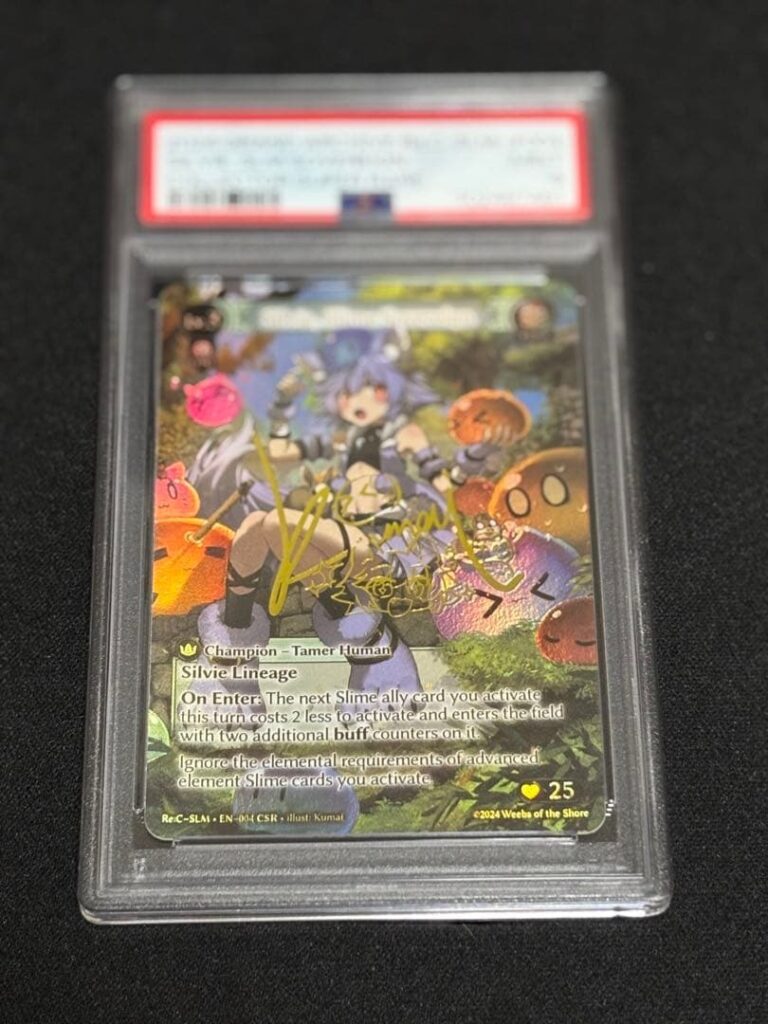
The Grand Archive CSR “Silvie, Slime Sovereign” listed on a Japanese marketplace.
What is Grand Archive TCG?
Grand Archive is a trading card game characterized by its anime-style artwork. Developed by Weebs of the Shore in the United States, it has released new sets regularly since its first set, Dawn of Ashes, in 2023. With an art style reminiscent of Japanese TCGs and a distinctive game system built around raising your champion in battle, it has built a community of players and collectors alike.
As of 2026, eleven sets have been announced, and the latest released set is “.asphodel/paradise” (August 21, 2026). The rarity system includes high-end collector treatments (CSR, CUR and others) as well as a First Edition / Alter Edition distinction, which also adds depth to the collecting side of the game.
This guide covers Grand Archive as of 2026: every set in release order, how to identify rarities and pull rates, the differences between First Edition and Alter Edition, trends among high-value cards, and how to buy cards from Japan.
Grand Archive TCG at a Glance
| Item | Details |
| Developer | Weebs of the Shore (USA) |
| First set | Dawn of Ashes (April 28, 2023) |
| Latest released set | .asphodel/paradise (August 21, 2026) |
| Next set | .asphodel/cantabile (scheduled for December 11, 2026) |
| Set types | Standard / Expansion / Capstone |
| Editions | First Edition / Alter Edition |
| Main rarities | C / U / R / SR / UR + collector rarities (CSR, CUR, CPR) |
Grand Archive Sets in Order
Latest Grand Archive set: .asphodel/paradise (Standard Set, released August 21, 2026)
| # | Set | Type | Release date | Status |
| 1 | Dawn of Ashes | Standard | April 28, 2023 | Released |
| 2 | Fractured Crown | Expansion | August 25, 2023 | Released |
| 3 | Alchemical Revolution | Standard | January 26, 2024 | Released |
| 4 | Mercurial Heart | Expansion | May 17, 2024 | Released |
| 5 | Mortal Ambition | Standard | October 11, 2024 | Released |
| 6 | Abyssal Heaven | Expansion | March 7, 2025 | Released |
| 7 | Distorted Reflections | Standard | July 25, 2025 | Released |
| 8 | Phantom Monarchs | Expansion | December 5, 2025 | Released |
| 9 | Radiant Origins | Capstone | April 3, 2026 | Released |
| 10 | .asphodel/paradise | Standard | August 21, 2026 | Released (latest) |
| 11 | .asphodel/cantabile | Expansion | December 11, 2026 | Upcoming |
Sets come in three types. A Standard Set is the large anchor set of each season, an Expansion Set builds on it, and a Capstone Set closes out a series as its culmination. Radiant Origins (April 2026) was Grand Archive’s first Capstone Set, and “.asphodel/paradise” (August 2026) opened a new group of sets.
2026 also saw Worlds 2026 / Ascent Worlds 2026 take place (see the official recap, published September 2, 2026).
How to Play the Game (Basic Rules)
A game of Grand Archive is about raising your champion while working to whittle down your opponent’s champion’s life. Its signature twist is the second deck: alongside your main deck, you run a Material Deck of material cards. Leveling up your champion over the course of the game, and “reserving” cards to pay costs, create a push-and-pull that is very much this game’s own.
A turn proceeds through seven phases. For the full details, the official rules documents are the most accurate source — refer to them when you’re ready to play seriously. The publisher also offers a free Print & Play (PDF), so you can get a feel for the game before spending anything.
Grand Archive TCG Rarity Guide
Pull rates vary by set and edition. For example, the official Dawn of Ashes Alter Edition article lists CSR at approximately 1 in 30 boxes.
Pack/Box Configuration
| Unit | Content |
| 1 pack | 8–12 cards (varies by set) |
| 1 box | 24 packs |
Rarity List (Low → High)
| Symbol | Name | Summary |
| C | Common | Standard cards with the highest pull rate |
| U | Uncommon | Intermediate rarity with a lower pull rate than Common |
| R | Rare | Basic rare with many practical cards |
| SR | Super Rare | High rarity with special processing. Multiple per box |
| UR | Ultra Rare | High rarity with 1 guaranteed per box |
| CSR | Collector Super Rare | Over-frame art + Artist signature gold stamp |
| CUR | Collector Ultra Rare | Over-frame art + Serial numbered stamp. Only in specific 1st Editions |
| CPR | Collector Promo Rare | Not-for-sale cards limited to tournaments/special events |
Rarity Details
C (Common) This is the rarity with the highest pull rate. It includes many cards that form the foundation of deck construction.
U (Uncommon) This is the rarity positioned between Common and Rare. It contains many support cards essential for deck building, and multiple copies are included in every pack.
R (Rare) The pull rate is lower than Common or Uncommon, and it contains many practical cards used in decks.
SR (Super Rare) Super Rares are cards with special processing, and multiple copies are included per box. Many are important for gameplay, leading to high demand from competitive players.
UR (Ultra Rare) Ultra Rare is a high rarity with one guaranteed copy per box. A foil version of a UR may also be included (roughly 1 in 8 packs), and it is possible for a regular UR and a foil UR to appear in the same box. This rarity is in high demand for both competitive play and collection.
CSR (Collector Super Rare) Collector Super Rares are characterized by over-frame art (design where the illustration extends beyond the card frame) and a gold stamp of the artist’s signature. The pull rate is extremely low (about 1 in 30 boxes in some sets), and there is high demand from collectors. Some CSRs have variants like “A-CSR” or “B-CSR.”
CUR (Collector Ultra Rare) Collector Ultra Rare is the highest rank of collector rarity. In addition to over-frame art similar to CSR, it features a unique serial number (sequential numbering) engraved on each card. They are only included in specific First Edition sets (such as Dawn of Ashes 1st Edition and Mercurial Heart 1st Edition) and are not included in Alter Editions. For example, only 72 copies of Mercurial Heart’s Tristan Shadowreaver CUR exist in the world.
CPR (Collector Promo Rare) These are not-for-sale cards distributed as prizes for tournament winners or participation rewards for special events. They are produced with specifications similar to CSR or CUR (over-frame art, signed, etc.). They cannot be obtained from packs or boxes, and their market price in the secondary market can reach anywhere from about ¥12,000 (around $80) to tens of thousands of yen or more.
Differences Between First Edition and Alter Edition
The concept of “Editions” exists for Grand Archive TCG cards, which greatly affects their value.
| Edition | Summary | Collection Value |
| First Edition | Original printing, sold first; carries the “1st Edition” stamp at the bottom. May feature edition-exclusive collector treatments or serialized cards depending on the set | High |
| Alter Edition | Later printing of the set. Core cards remain largely shared, but collector rarities, artwork, treatments, and in some cases functional cards can differ by set (e.g., Dawn of Ashes Alter Edition added 5 new functional cards) | Lower |
※ In most cases, First Editions trade at higher prices even for the same rarity. CURs only exist in specific First Edition sets and are not included in Alter Editions.
Source: First and Alter Edition — official article
How to Identify Rarities
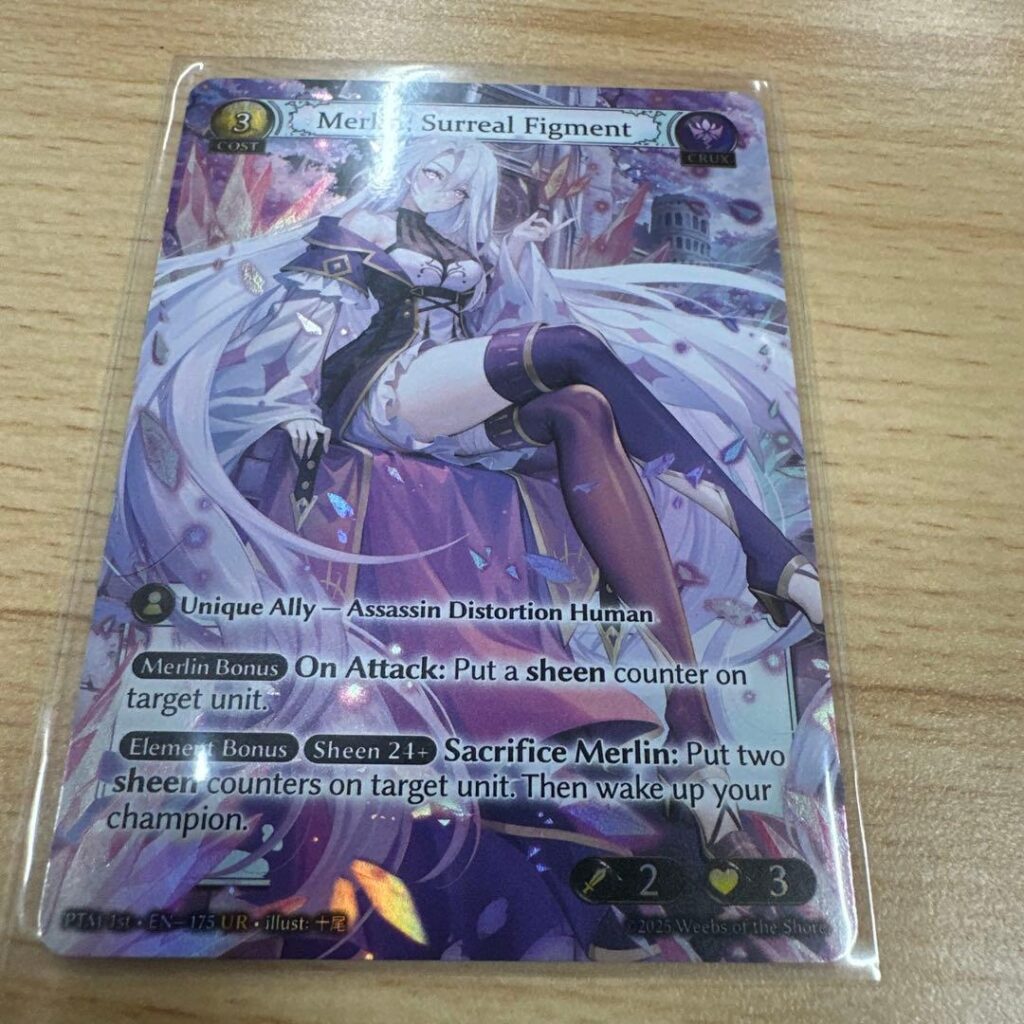
A foil UR single — the bottom-left line shows the set code, the “1st” edition mark, the card number and the UR rarity symbol.
Basic: Look at the colored symbol at the bottom left
A card’s rarity is indicated by the colored symbol described in the text area at the bottom left (next to the set code + number).
| Symbol | Symbol Color | Rarity |
| C | White (Plain) | Common |
| U | Green | Uncommon |
| R | Blue | Rare |
| SR | Purple | Super Rare |
| UR | Orange | Ultra Rare |
| CSR | White (Outlined) | Collector Super Rare |
| PR | Light Pink | Promo Rare |
C through UR can be identified instantly just by looking at the color of the symbol.
Identifying Higher Rarities (CSR, CUR, CPR)
Not just the color, but the appearance of the card itself changes significantly.
Features of CSR (Collector Super Rare)
- Over-frame art: The illustration overflows beyond the card frame.
- Artist’s gold signature: A stamp of a handwritten-style signature on the front of the card.
- Variant notation: Some cards add an A or B before the symbol, such as “A-CSR” or “B-CSR.”
- CSRs included in Alter Editions have the same stamp across all cards.
Features of CUR (Collector Ultra Rare)
- Over-frame art + Artist signature similar to CSR.
- Additionally, a serial number (sequential number) is engraved (e.g., 1/70, 72/72).
- The design of the signature is completely different for each card (while CSR uses the same stamp for all, CUR is unique to each card).
- Cards with lower numbers (especially “1/70”) tend to fetch higher prices in the collector market.
Features of CPR (Collector Promo Rare)
- Specifications similar to CSR or CUR (over-frame art, signed).
- “CPR” is described at the bottom left of the card.
- The design differs depending on the acquisition method (tournament, event).
About Foil Cards
In Grand Archive TCG, a foil version (Parallel Foil) exists for cards of any rarity. The pull rate is relatively low at about 1 in every 8 packs, and combinations such as Foil UR or Foil CSR exist. Since being foil is on a different axis from rarity, it is most accurate to judge rarity based on the color of the symbol + the presence of over-frame art.
Identification Flow
When you have a card in hand, check in the following order:
- Illustration overflows from the card frame → One of CSR / CUR / CPR.
- Serial number is engraved → CUR (Highest rarity).
- No serial number → CSR or CPR.
- Contained within the frame → Check the color of the symbol at the bottom left (Orange → UR / Purple → SR / Blue → R / Green → U / White, plain → C).
- Entire card is shiny → Foil version (separate from rarity).
High-Value Card Examples
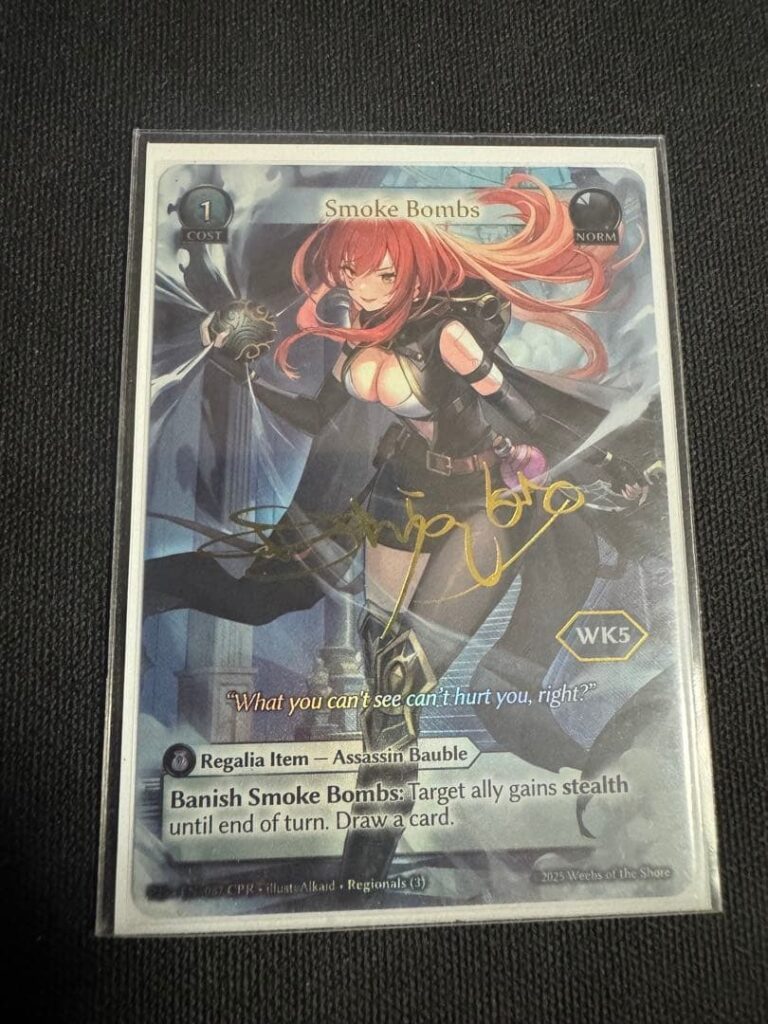
A CPR (Collector Promo Rare) single with the gold artist signature; “CPR” is printed at the bottom left.
Secondary-market prices fluctuate significantly by card, edition, and condition.
Cards that tend to get high prices in the secondary market:
- CUR (Collector Ultra Rare) First Edition: Serial numbered and only tens to hundreds exist in the world. Recorded sales range from tens of thousands of yen to over ¥100,000.
- CPR (Collector Promo Rare): Not-for-sale cards limited to tournaments and events. About ¥12,000 (around $80) to tens of thousands of yen or more.
- CSR (Collector Super Rare): Featuring over-frame art and artist signatures. Thousands to tens of thousands of yen.
- UR First Edition: Price differences tend to appear more easily compared to Alter Edition.
※ Note: “UR (Ultra Rare)” is a formal rarity of Grand Archive TCG. Please be careful not to confuse it with rarities of other TCGs when searching for “UR.” Also, CUR is not included in all First Editions but exists only in specific sets.
For expensive cards, condition and authenticity checks matter — before chasing the top-end cards, see our guide on how to avoid scammers when buying second-hand TCG cards.
Community & Information Gathering
- Official Website: gatcg.com
- Official Card Database Index: index.gatcg.com (Print counts and foil counts for each card can be confirmed)
- Reddit: r/grandarchivetcg (over 5,000 members)
- Discord: Official community server (over 14,000 members)
How to Buy Cards
Grand Archive TCG is mainly distributed in English-speaking regions. While there are cases where cards are traded in Japanese domestic marketplaces, purchasing from overseas involves language barriers and issues with shipping support.
- Few stores outside English-speaking markets carry Grand Archive TCG.
- Rare cards listed only within Japan may circulate on Yahoo! Auctions or Mercari.
- Direct access to English sites or personal imports can be time-consuming.
→ This can be solved by using Neokyo.
By using Neokyo, for Grand Archive TCG cards listed in the Japanese domestic marketplace, you can:
- Search: Search Japanese sites with an English interface.
- Proxy Purchase: Proxy bidding and direct purchase.
- Inspection: Check the condition after purchase.
- Packing/Shipping: International shipping worldwide with safe packing.
Obtain rare cards such as CUR, CPR, and CSR from anywhere in the world with peace of mind.
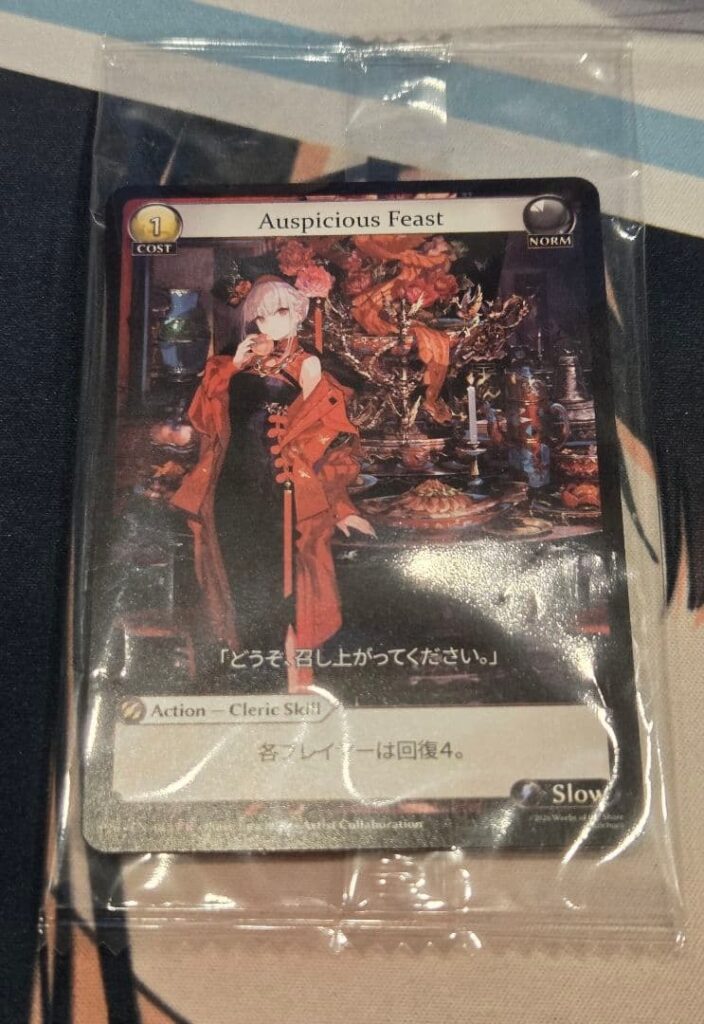
A sealed Grand Archive promo card listed on Mercari.
Search keywords for the Japanese market: On Japanese marketplaces (Mercari, Yahoo! Auctions and others), listings use both the katakana spelling 「グランドアーカイブ」 and the English “Grand Archive” — searching with both is the reliable way. Set names mostly appear in English as-is (“Dawn of Ashes” and so on).
Why buy from Japan: Grand Archive circulates mainly in English-speaking markets, but Japanese marketplaces (Mercari, Yahoo! Auctions and others) do carry single cards and sealed products. Reading Japanese listing pages, dealing with sellers, buying from listings that don’t ship internationally — Neokyo’s proxy purchasing service handles that language-and-logistics barrier in one place. The flow works the same as for any other purchase: submit a purchase request, Neokyo buys and inspects the item in Japan, then ships it to your address.